
2 days
A weekend in Jeonju Hanok Village
Two days in Korea’s largest urban hanok district: the founder’s shrine, the view from Omokdae, a Confucian school, and a night under a tiled roof.
Jeonju’s hanok village is compact enough to walk end to end in twenty minutes, but it rewards a slower pace, and it is the easiest place in Korea to sleep in a hanok. Two days let you see its royal and Confucian monuments by day and the lanes when the day-trippers have gone.
Most of the houses are 20th-century city hanok built by Koreans outside the old south gate; the monuments around them are far older. Keep both in mind as you walk.
-
Day 1, arrival: Jeondong Cathedral and Taejo-ro
From Jeonju Station take a city bus (the city lists 79, 101, 112, 119, 508, 536, 542, 545, 546 and 999) to the Jeondong Cathedral (Hanok Village) stop, about 25 minutes. Start at the brick cathedral, built on the execution ground of early Catholics, then check in to your hanok and walk up Taejo-ro.
-
Day 1, afternoon: Gyeonggijeon
The shrine to King Taejo, founder of the Joseon dynasty, founded in 1410 and rebuilt in 1614. Notice the strict axis and the triple gates, the opposite of the inward-looking houses outside its wall. Allow an hour; it is just up Taejo-ro from the cathedral.
-
Day 1, late afternoon: Omokdae
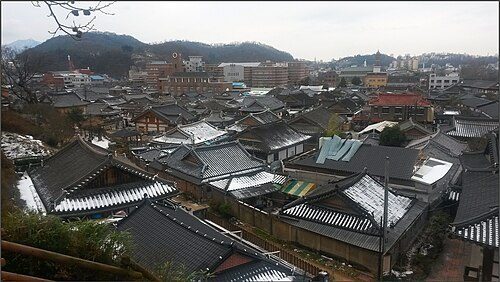
Climb to the hilltop pavilion where Yi Seong-gye is said to have rested in 1380, for the classic view over hundreds of tiled roofs. Go back down into the side lanes of Gyo-dong as the light fades, when the village is quieter.
-
Night: a hanok stay
Sleep in one of the village’s hanok guesthouses. If your room has an ondol (온돌) heated floor with bedding laid on it, a cool night is the best way to understand the system. Book ahead for weekends and holidays.
-
Day 2, morning: Jeonju Hyanggyo
Walk to the local Confucian school within the village, whose shrine hall was rebuilt in 1653. See how the shrine for Confucius and the lecture hall are laid out, and compare it with Gyeonggijeon’s royal formality. Allow 45 minutes.
-
Day 2, late morning: the residential lanes
Before you leave, walk the quieter alleys away from Taejo-ro, where people still live. Look at roof curves, glass windows and paper doors, and notice which houses have been converted to shops: by a 2023 count almost every building on the main street had changed from home to business.
Tips
- Weekdays are much calmer than weekends.
- Hanok stays vary from simple rooms with shared bathrooms to restored houses with private facilities; check before booking.
- From the express bus terminal, buses 79, 999 and 1994 run to the same Jeondong Cathedral stop in about 15 minutes.
When to go
Spring and autumn are the most comfortable and most popular; book the hanok stay early. Winter is quiet and the heated floors are at their best.
Sources
- 찾아오시는 길, Jeonju City (Jeonju Hanok Village) (read 15 November 2026)
- 전주한옥마을 현황, Jeonju City (Jeonju Hanok Village) (read 15 November 2026)
- 전주 경기전, Korea Heritage Service (National Heritage Portal) (read 15 November 2026)
- 오목대이목대, Korea Heritage Service (National Heritage Portal) (read 15 November 2026)
- 전주향교, Korea Heritage Service (National Heritage Portal) (read 15 November 2026)
- 전주 전동성당, Korea Heritage Service (National Heritage Portal) (read 15 November 2026)
- [전주한옥마을이 위태롭다](2)원인-무분별 개발, 방문객 지갑만 노리는 관광지화, Jeonbuk Ilbo (read 15 November 2026)