

Jeolla · Jeonju, Jeonbuk State · City hanok quarter
Jeonju Hanok Village 전주한옥마을
Jeonju Hanongmaeul
Some 735 hanok in Gyo-dong and Pungnam-dong, built by Koreans from the 1910s-30s beside the shrine of Joseon’s founder.
Overnight staysLived in
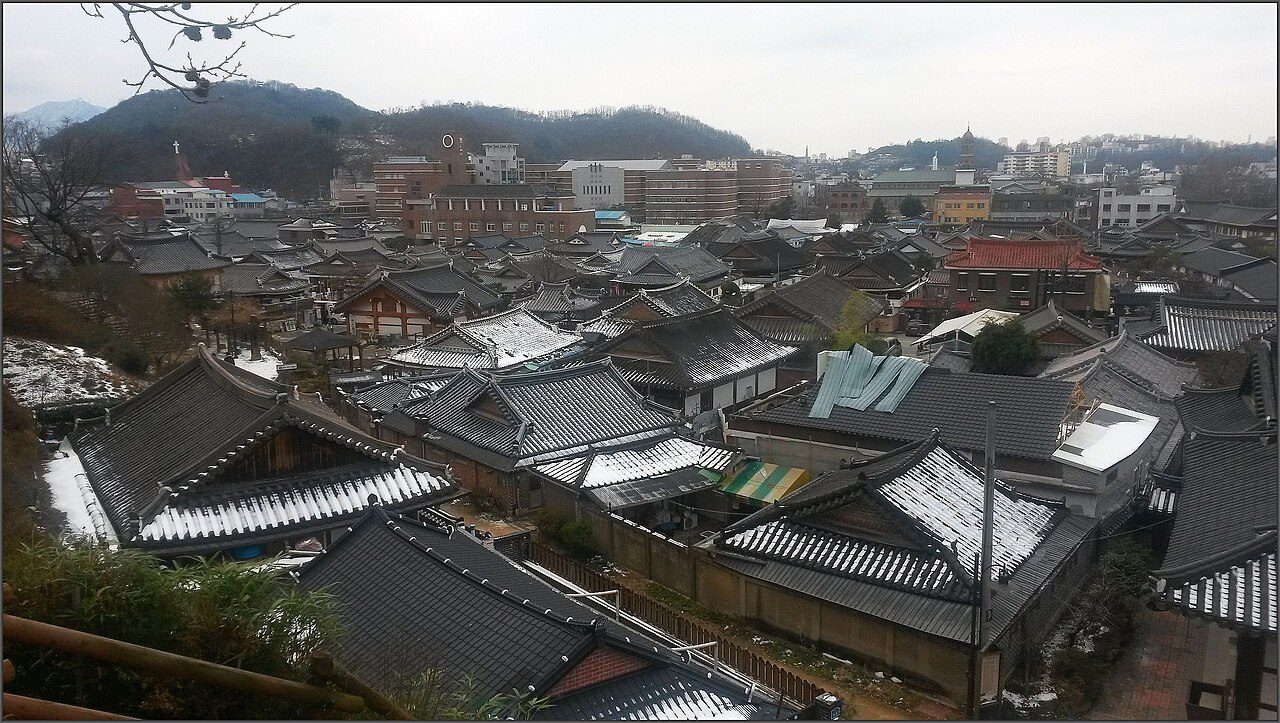
Jeonju Hanok Village is a whole quarter of tiled houses in the centre of a modern city: on the city’s own count, 735 hanok (한옥) among 947 buildings across about 30 hectares of Gyo-dong and Pungnam-dong. It is the largest urban hanok district in Korea and the easiest place in the country to sleep in one: many houses now take overnight guests.
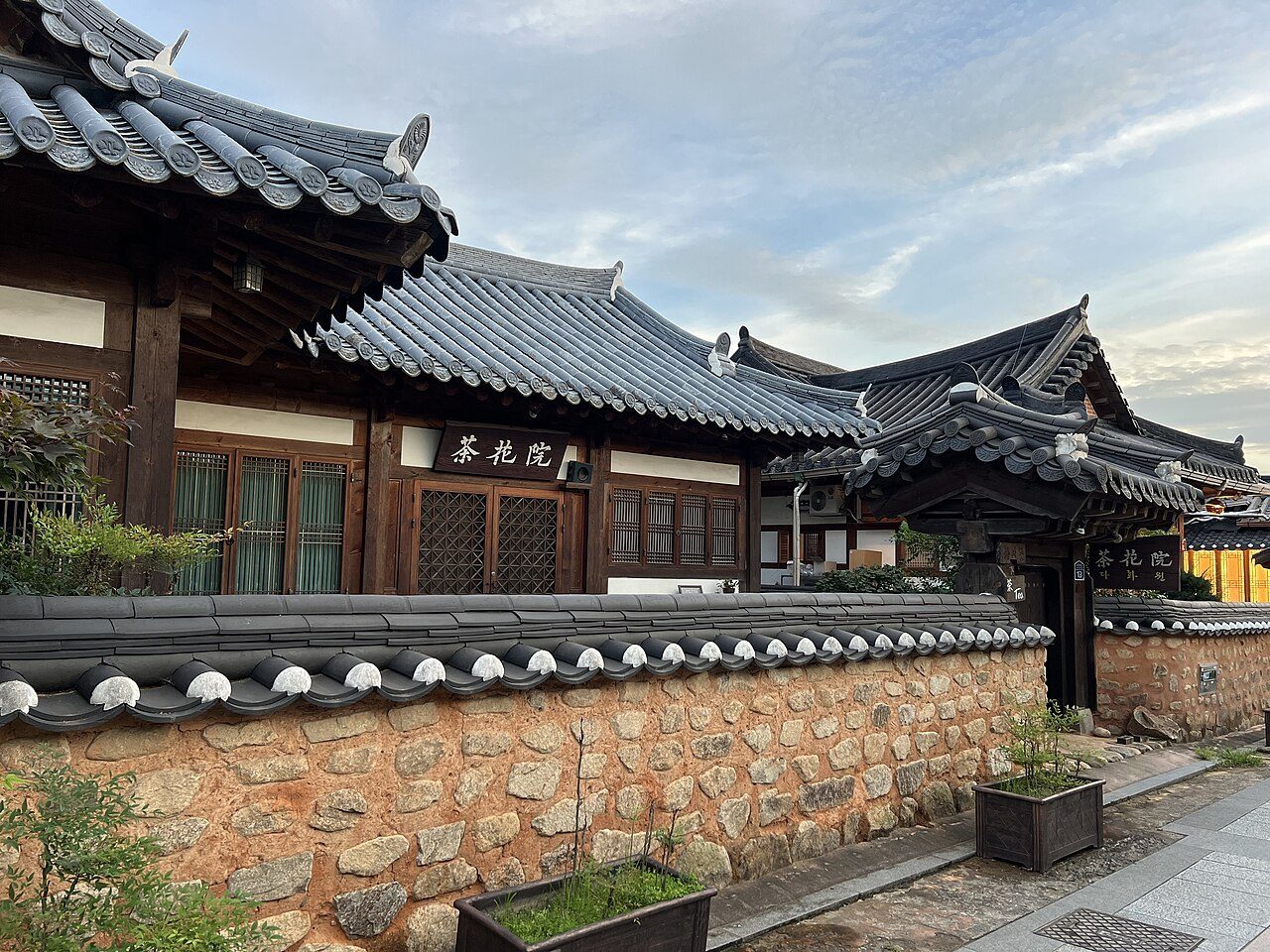
Like Bukchon, most of what you see is not Joseon-era architecture but the 20th-century urban hanok, with glass windows, sliding doors and indoor plumbing behind traditional roofs. What makes Jeonju different is its setting. The houses grew up around Gyeonggijeon, the shrine of the founder of the Joseon dynasty, the local Confucian school and the old south gate, so the district mixes everyday houses with some of the dynasty’s most symbolic buildings.
What to look at
Gyeonggijeon 경기전
The shrine to King Taejo, with the main hall rebuilt in 1614 and designated a Treasure. Unlike a house, it is laid out on a strict axis behind outer and inner triple gates, with a raised central path for the spirit. Compare its formal plan with the informal, inward-looking houses just outside its walls.
Taejo-ro and the side lanes 태조로
The main street is now almost entirely shops; step into the side alleys of Gyo-dong to see houses still lived in. Look at roofs with strongly upturned eaves, and at windows of glass rather than hanji (한지) paper, both features of 20th-century urban hanok.
Omokdae 오목대
A hilltop pavilion on the spot where Yi Seong-gye is said to have rested after defeating Japanese raiders in 1380, marked by a stele in Emperor Gojong’s calligraphy erected in 1900. It gives the best view over the sea of tiled roofs.
Jeonju Hyanggyo 전주향교
The local Confucian school, moved to this site after the 1590s invasions. Its shrine hall was rebuilt in 1653. Look at the classic layout of a hyanggyo: a lecture hall for students and, behind or beside it, a shrine for Confucius and the sages, still used for rites in spring and autumn.
Jeondong Cathedral 전동성당
A brick Romanesque-Byzantine church built on the execution ground of early Korean Catholics outside the south gate, designed by a French priest. It stands at the entrance to the hanok village, a sharp visual contrast with the timber houses beyond.

History
Jeonju is the ancestral home of the royal Yi clan: by tradition the family lived here until Yi An-sa, the fifth-generation ancestor of Yi Seong-gye (King Taejo), moved north, and the site of his birthplace is marked beside Omokdae. In 1410 a portrait hall for the dynasty’s founder was set up here, as in two other cities; the Jeonju hall was given the name Gyeonggijeon in 1442, burned during the Japanese invasions of the 1590s and was rebuilt in 1614.
The hanok quarter itself is younger. The city’s official history dates the start of its formation to 1910. Japanese authorities demolished Jeonju’s walls around 1911, except for the south gate Pungnammun, and Japanese merchants moved into the old walled centre; according to a 2023 Jeonbuk Ilbo history, Korean residents increasingly settled outside the south gate in Gyo-dong and Pungnam-dong from the 1930s, building the curved-roofed modern hanok that define the district. Japanese-style houses still stand along Taejo-ro, the main street.
The city designated parts of Gyo-dong and Pungnam-dong a hanok preservation district in 1977, capped buildings at two storeys in 1987, began funding hanok repairs under a 2002 ordinance and was named an International Slow City in 2010. Success has brought strain: the same 2023 Jeonbuk Ilbo report found that the registered population of the village fell from 2,339 in 2008 to 903, and that almost every building on Taejo-ro had been converted from housing to shops.
Getting there
KTX to Jeonju Station, then city bus (e.g. 79, 112, 119, 999) to the Jeondong Cathedral (Hanok Village) stop, about 25 min
Take a KTX or other Korail train to Jeonju Station. From the bus stop at the station, the city’s hanok village site lists buses 79, 101, 112, 119, 508, 536, 542, 545, 546 and 999 to the stop in front of Jeondong Cathedral (Hanok Village), about 25 minutes.
From the express bus terminal, buses 79, 999 and 1994 run from the Bulgyo Hall stop to the same Jeondong Cathedral stop in about 15 minutes.
Route checked 15 November 2026 against: 찾아오시는 길 (Jeonju City (Jeonju Hanok Village)). Bus numbers and stops change: check the official page before you set off.
When to go
SpringSummerAutumnWinter
Spring and autumn are mild and suit walking; both are also high season, so book a hanok stay ahead for weekends and holidays. Weekdays are noticeably calmer than weekends.
On screen
- Mr. Sunshine (2018, drama): Manhyujeong pavilion and Okyeonjeongsa, Andong; Hagindang house, Jeonju Hanok Village
- Love in the Moonlight (2016, drama): Jeonju Hyanggyo and Gyeonggijeon, Jeonju Hanok Village
- Jeongnyeon: The Star Is Born (2024, drama): Hagindang (Injae gotaek), Jeonju Hanok Village
Sources
- 전주한옥마을 현황, Jeonju City (Jeonju Hanok Village) (read 15 November 2026)
- Jeonju Hanok Village, VisitKorea (Korea Tourism Organization) (read 15 November 2026)
- [전주한옥마을이 위태롭다](2)원인-무분별 개발, 방문객 지갑만 노리는 관광지화, Jeonbuk Ilbo (read 15 November 2026)
- 전주 경기전, Korea Heritage Service (National Heritage Portal) (read 15 November 2026)
- 전주 경기전 정전, Korea Heritage Service (National Heritage Portal) (read 15 November 2026)
- 오목대이목대, Korea Heritage Service (National Heritage Portal) (read 15 November 2026)
- 전주향교, Korea Heritage Service (National Heritage Portal) (read 15 November 2026)
- 전주 전동성당, Korea Heritage Service (National Heritage Portal) (read 15 November 2026)
- 찾아오시는 길, Jeonju City (Jeonju Hanok Village) (read 15 November 2026)