

Seoul · Jongno-gu, Seoul · City hanok quarter
Bukchon Hanok Village 북촌한옥마을
Bukchon Hanok Maeul
Seoul’s densest cluster of lived-in hanok: 1920s-30s townhouses on old aristocratic land between two palaces, with visiting hours enforced.
Overnight staysLived in
Bukchon, the ‘northern village’, is the hillside between Gyeongbokgung and Changdeokgung palaces, north of the old Jongno high street. It is not a museum and not a theme park. Around a thousand hanok (한옥) still stand here, and most of them are family homes, which is exactly why the district is worth seeing and why it now has rules about when you may look.
What you are mostly looking at is not the Joseon aristocracy’s houses but what replaced them: compact urban hanok built in rows by developers in the 1920s and 1930s, on land carved out of large yangban (양반) estates. They keep the tiled roofs, timber frames and courtyards of the older tradition, squeezed onto small plots and updated with glass, plumbing and tin gutters. Bukchon is the best place in Korea to see how the hanok adapted to city life.
What to look at
Bukchon-ro 11-gil (the Gahoe-dong slope) 북촌로11길
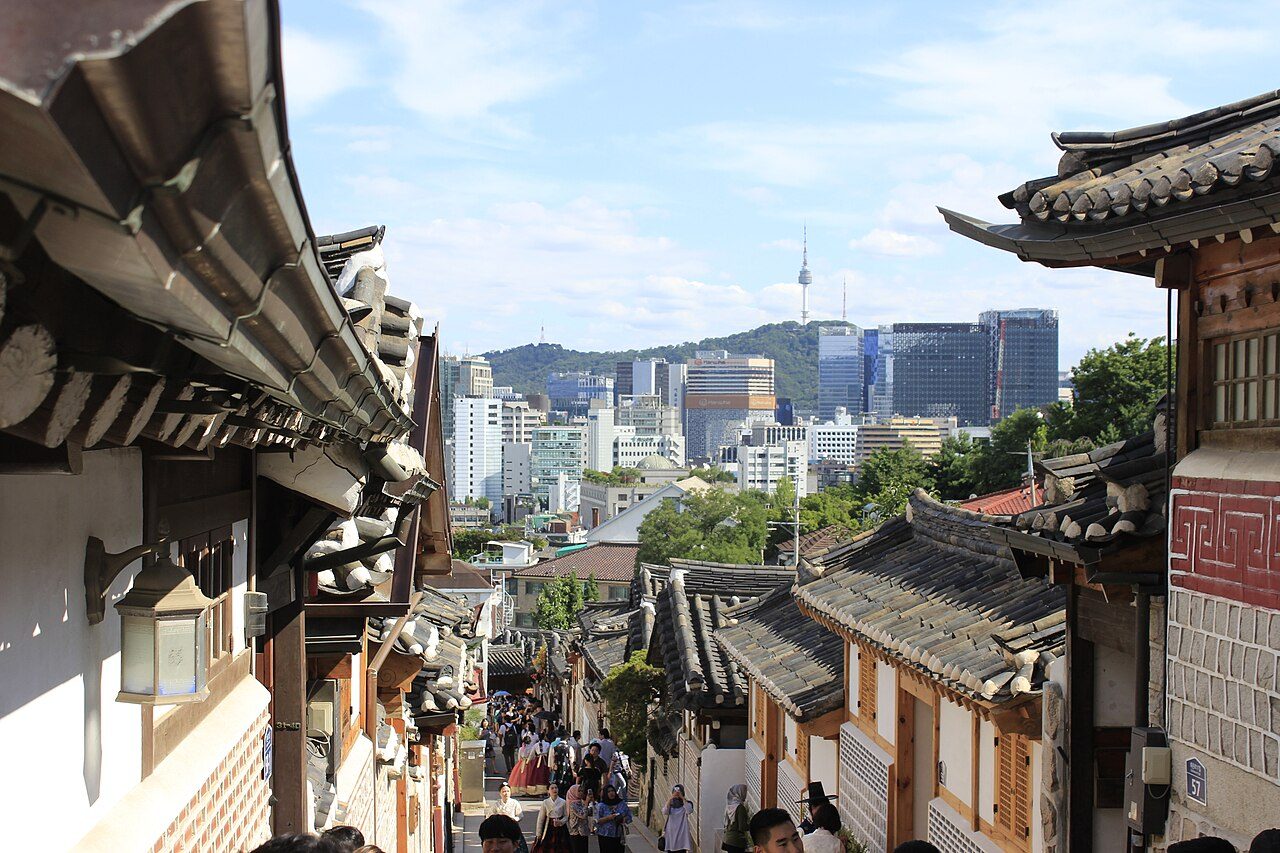
The famous view of tiled roofs stepping down towards the city towers. Look at how tightly the houses abut: each plot is a fraction of an estate, so walls are shared and the giwa (기와) roofs nearly touch. This is the red zone, so come between 10:00 and 17:00 and keep your voice down.
Baek In-je House 백인제가옥
A large 1913 house built by a banker, with black pine from the Amnok (Yalu) River, red brick, plenty of glass and even a partly two-storey guest wing. Unusually, a corridor links the men’s and women’s quarters so nobody had to go outdoors. The interior is shown on guided tours run by the Seoul Museum of History.
Developer-built rows in Gye-dong and Gahoe-dong 도시한옥
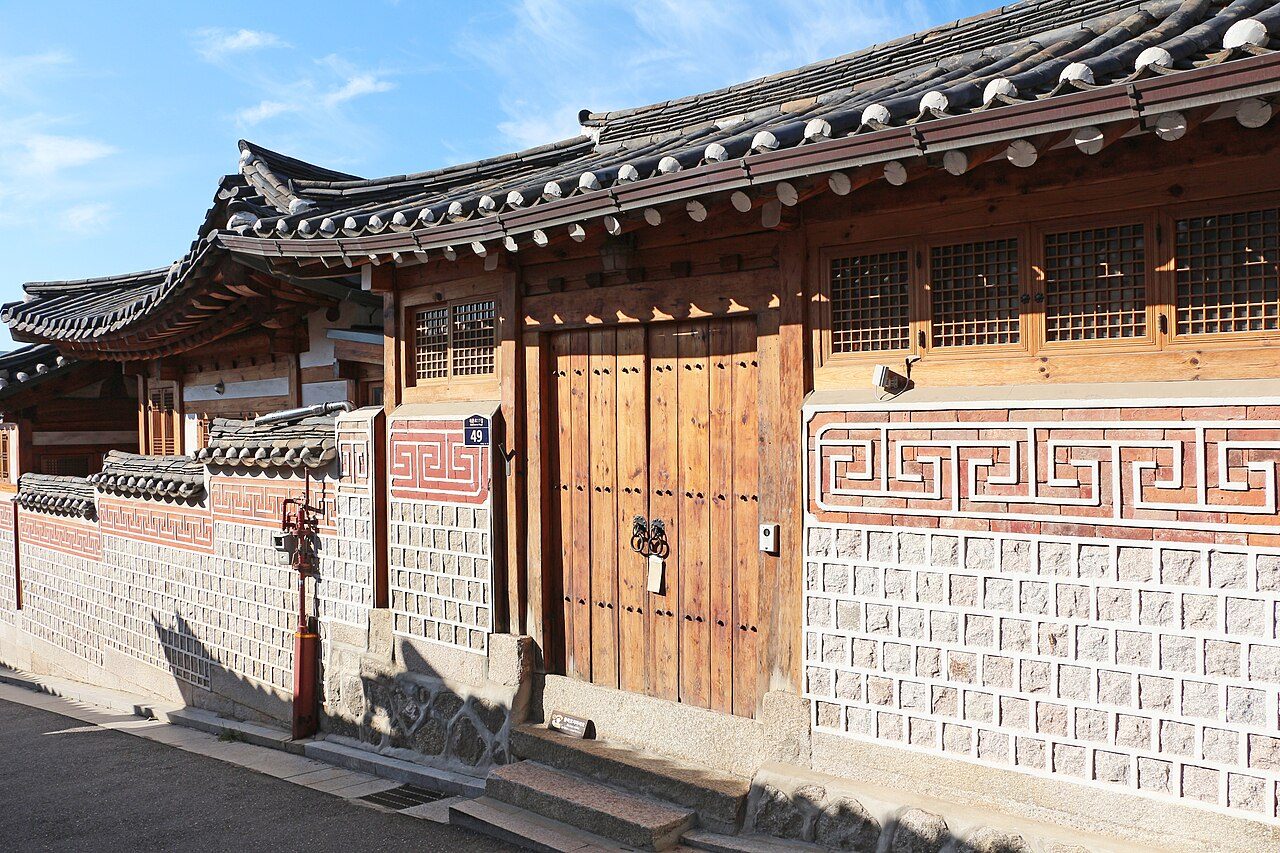
Walk any side lane and count the identical gates. Note the glazed sliding doors across the daecheong (대청) hall and the strip of metal under the eaves: both were 1920s-30s additions that made the hanok workable as a city house.
Bukchon Traditional Culture Center 북촌전통문화센터
A hanok run as a cultural centre with free entry, classes and exhibitions; a good place to see a courtyard and wooden lattice up close without intruding on anyone. Closed on Mondays.
Views towards the palaces 북촌 8경
The district’s ‘eight views’ route marks numbered viewpoints, starting with a look over Changdeokgung and including the Gahoe-dong slopes and the stone stairway in Samcheong-dong. From the higher lanes you can see how the village sits on the palace hills, the same siting that made it desirable for the Joseon elite.

History
Under the Joseon dynasty the slopes north of Jongno were a favoured address for royal relatives and high-ranking scholar-officials, who built large walled compounds within easy reach of the palaces. A late-Joseon chronicler quoted in later histories described the area north of the bell pavilion as the quarter of the dominant Noron faction, while lower-ranking officials and impoverished gentry lived south of the stream in Namchon.
The neighbourhood that survives took shape under Japanese colonial rule. Around 1920 the developer Jeong Se-gwon (1888-1965) founded a building company, Geonyangsa, that bought up big estates in Gahoe-dong, Samcheong-dong, Ikseon-dong and elsewhere, subdivided them and put up groups of small hanok for middle-income Korean families, sold on instalments. His houses kept a central maru (마루) hall with rooms around a courtyard but added running water, electricity, an indoor toilet, glass doors on the hall and metal awnings along the eaves. Seoul’s own history of him presents this as a deliberate effort to keep Korean households in the city centre as Japanese settlement spread north; he put profits into the Korean Language Society and was posthumously decorated in 1990.
Preservation came later and in fits. After 1970s development brought large buildings into the area, Seoul designated Bukchon a folk landscape area in 1976 and tightened controls in 1983; the preservation zone was abolished in 1999, and multi-unit housing began to replace hanok. In 2001 the city switched to incentives: a dedicated Bukchon programme ran from 2001 to 2006, and owners who registered their houses as hanok became eligible for repair grants of up to two-thirds of the cost.
Popularity then became the problem. Jongno-gu designated a special management area and, after a trial from 1 November 2024, began fining tourists from 1 March 2025 for being in the ‘red zone’ along Bukchon-ro 11-gil between 17:00 and 10:00. A ban on chartered tour buses along Bukchon-ro and nearby streets followed, with fines from 1 January 2026.
Getting there
Seoul Subway Line 3 to Anguk Station, then a 10-15 minute walk uphill
Take Seoul Subway Line 3 to Anguk Station. Visit Seoul lists Exit 3 for the main village address on Gyedong-gil (about 500 m); Exit 2 also leads up Bukchon-ro. From either, walk north and uphill; the Gahoe-dong lanes are near the top.
Chartered tour buses are banned from Bukchon-ro and the nearby streets, so arrive by subway, city bus or on foot. Bukchon is an easy walk from Changdeokgung Palace to the east and from Gyeongbokgung and Samcheong-dong to the west.
Route checked 15 November 2026 against: Bukchon Hanok Village (Visit Seoul (Seoul Tourism Organization)); Bukchon special management area visitor restrictions (notice, 2024.11-) (Seoul Metropolitan Government). Bus numbers and stops change: check the official page before you set off.
When to go
SpringSummerAutumnWinter
Spring and autumn give mild walking weather on what is a steep district. Weekends and holiday afternoons are crowded on the Gahoe-dong slope; a weekday morning just after 10:00, when the red zone opens, is calmest. The lanes are pretty after snow but icy on the inclines.
On screen
- Personal Taste (2010, drama): Bukchon Hanok Village, Seoul (gate of the house ‘Sanggojae’); interiors on a studio set
- Assassination (2015, film): Baek In-je House, Gahoe-dong, Bukchon, Seoul
Sources
- Bukchon Hanok Village, VisitKorea (Korea Tourism Organization) (read 15 November 2026)
- Bukchon Hanok Village, Visit Seoul (Seoul Tourism Organization) (read 15 November 2026)
- 북촌 특별관리지역 관광객 방문 제한 안내 (2024.11.~), Seoul Metropolitan Government (read 15 November 2026)
- Seoul’s Bukchon Hanok Village to enforce tourism curfew from Saturday, Korea JoongAng Daily (read 15 November 2026)
- 그가 없었다면 지금의 북촌은 없었다! 건축왕 정세권 이야기, Seoul Metropolitan Government (Mediahub) (read 15 November 2026)
- 한옥 (기록으로 만나는 대한민국), National Archives of Korea (read 15 November 2026)
- 북촌과 남촌, 옛 골목을 거닐다, Weekly Kyunghyang (read 15 November 2026)
- BaekInje’s House Museum, Seoul Museum of History (read 15 November 2026)
- Bukchon Traditional Culture Center, Visit Seoul (Seoul Tourism Organization) (read 15 November 2026)
- Eight Scenic Views of Bukchon, VisitKorea (Korea Tourism Organization) (read 15 November 2026)
- 북촌 한옥 보존 사업 (2002-12-26), Seoul Shinmun (read 15 November 2026)
- 600년 수도의 역사를 품은 한옥촌, ‘북촌한옥마을’을 가다, Seoul Metropolitan Government (Mediahub) (read 15 November 2026)