

Seoul · Jongno-gu, Seoul (inside Changdeokgung Palace) · Palace residence
Yeongyeongdang 창덕궁 연경당
Changdeokgung Yeongyeongdang
A scholar-official’s house built inside a royal garden: unpainted, with separate men’s and women’s courts, from the 1820s.
UNESCO
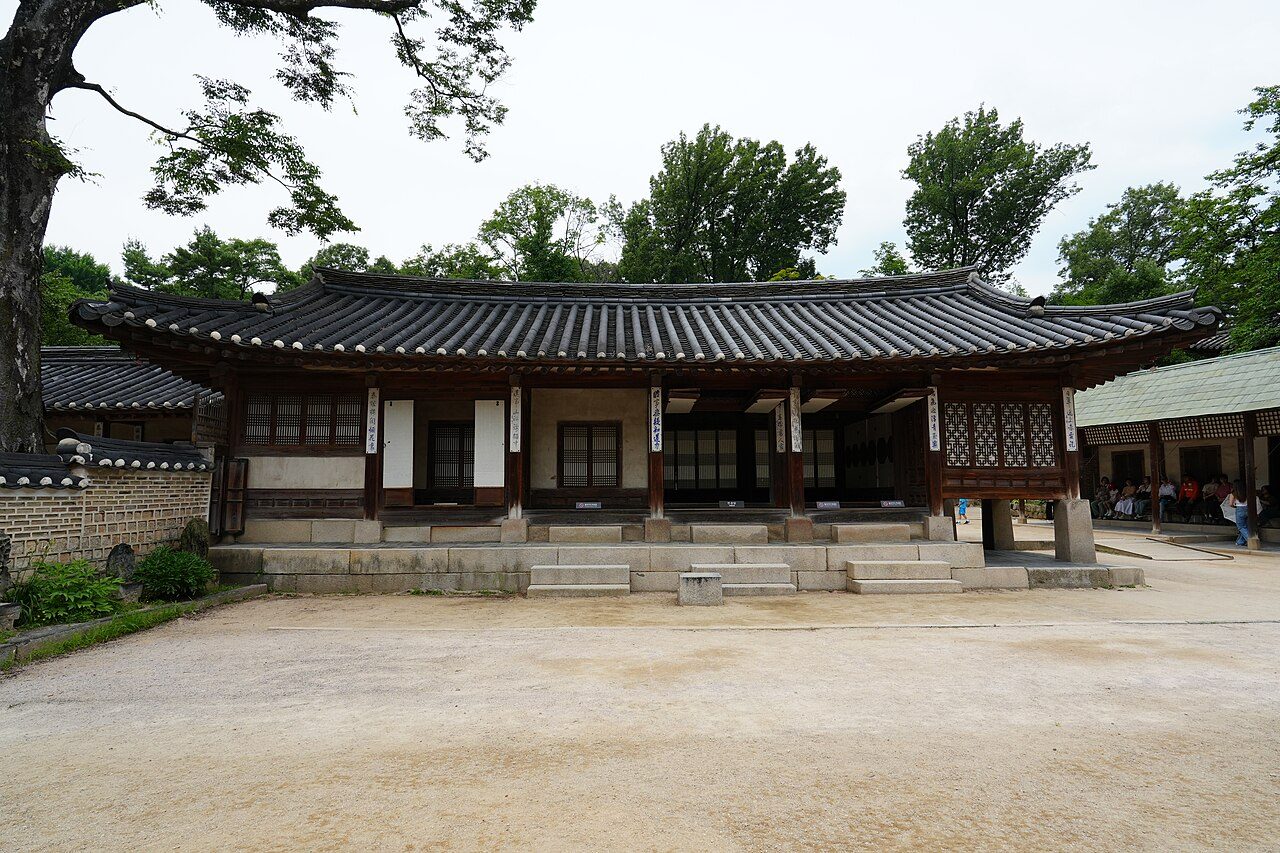
Yeongyeongdang sits in a fold of the rear garden (Huwon) of Changdeokgung Palace, and it is a curiosity: a residence built by royalty in the style of a sadaebu (사대부), a scholar-official’s family house. There are no painted dancheong (단청) patterns, no bracket clusters, no throne. Instead you get the plan of an upper-class Seoul home, with a men’s wing and a women’s wing, a gate wing for servants and a study, all built with palace craftsmanship.
For a visitor it is the clearest single lesson in how a yangban (양반) house was organised. Because it was designed all at once, by court builders who knew the rules, the separation of men’s and women’s space and the hierarchy of gates and courtyards are laid out more cleanly here than in most real family houses that grew over generations.
What to look at
Jangnakmun and the two inner gates 장락문
Through the outer gate you face two entrances: a tall sosseul daemun (솟을대문) gate on the right into the men’s courtyard, and a plain, lower gate on the left to the women’s quarters. The heights of the two gates tell you whose space lies beyond.
The sarangchae (Yeongyeongdang proper) 사랑채
The men’s wing, which originally carried the name Yeongyeongdang. It is six bays wide with a raised nu-maru (누마루) at one end. Its purlins are round in section while the women’s wing uses square ones, a detail the heritage record reads as deliberate obedience to rank and gender rules.
The anchae 안채
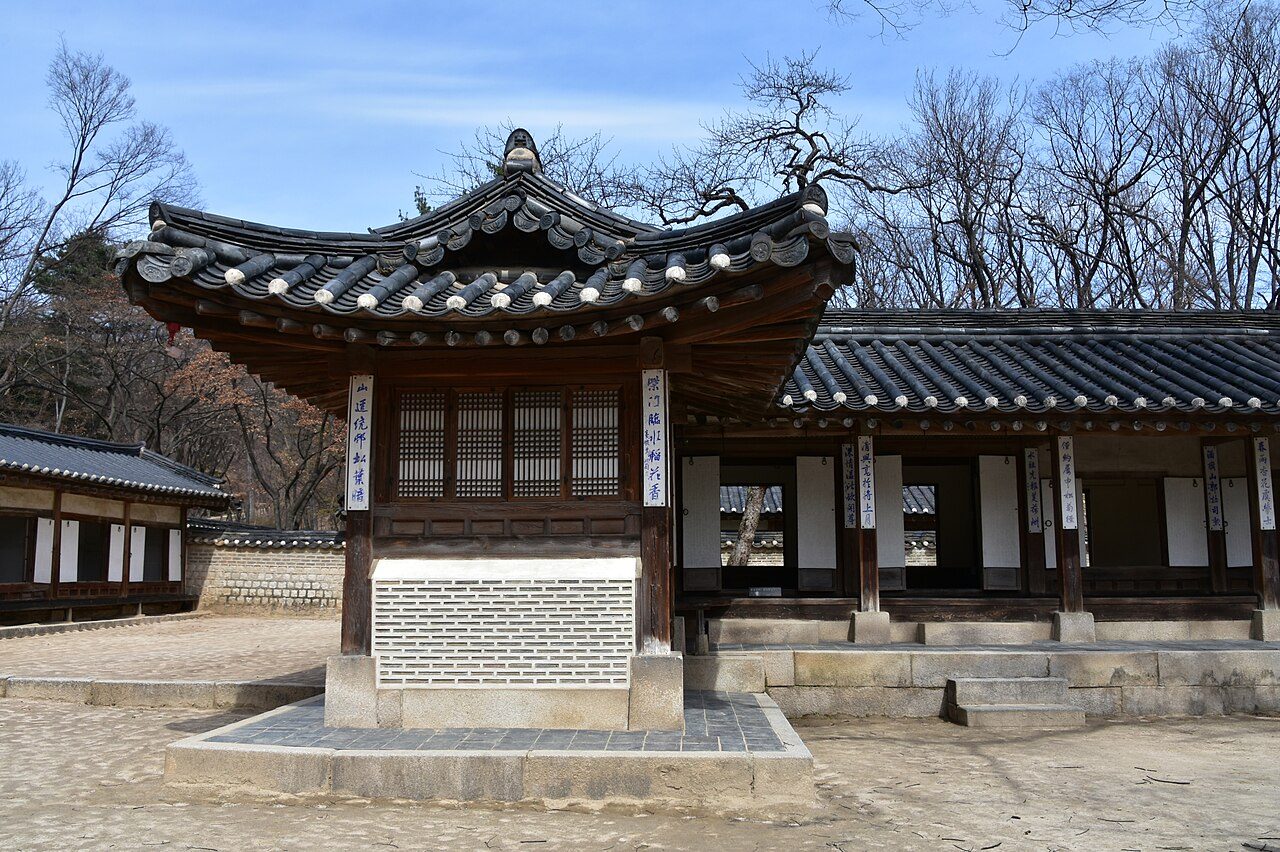
The women’s wing sits behind a wall that bends between the two courtyards, yet a narrow wooden passage at the back connects it to the sarangchae, closed by a board door. Separate in public, joined in private.
Seonhyangjae 선향재
The study and library in the east yard beside the men’s wing, where books were kept and read. That a palace residence has a dedicated study, set apart from the living rooms, is itself a statement of the scholar-official ideal the house imitates.
Nongsujeong and the terraced garden 농수정
Behind the study, stepped flower terraces (hwagye, 화계) climb the slope to a small pavilion, the only building here with bracket work. The terraces are a typical way of turning a hill behind a house into a garden.

History
Yeongyeongdang was commissioned by Crown Prince Hyomyeong, who ran the government for his father King Sunjo in the late 1820s, as a setting for a ceremony honouring Sunjo and Queen Sunwon. Contemporary records disagree on the year: one gazetteer gives 1827, the palace record 1828. The Korea Heritage Service dates it to about 1827-28; the Encyclopedia of Korean Culture, after comparing court records and the ‘Donggwoldo’ painting of the palace, argues for 1827.
The house went through several phases. After the prince’s death it held his portraits; in 1857 these were moved because the site was judged cold and damp, and the building stood empty for a time. Court records cited by the Encyclopedia of Korean Culture mention new construction in 1846 and repairs in 1865, and the Encyclopedia concludes that the house reached its present form under King Gojong. A Seoul government account states the present building dates from 1868. Under Gojong it was used to receive foreign envoys and hold banquets.
The house is popularly called a ‘99-kan house’, after the legal limit on the size of private homes, but the Encyclopedia measures it at about 109 kan, and the palace record lists 120. It was designated a Treasure in 2012 and is part of the Changdeokgung complex, a UNESCO World Heritage Site since 1997.
Getting there
Seoul Subway Line 3 to Anguk Station, Exit 3; Yeongyeongdang is reached only on a Secret Garden guided tour
Take Seoul Subway Line 3 to Anguk Station, Exit 3; the Donhwamun gate of Changdeokgung is a few minutes’ walk east. Buy a palace ticket and a separate Secret Garden (Huwon) ticket.
Yeongyeongdang lies inside the Huwon, which can only be visited on a guided tour. English tours run several times a day; places are split between online booking and on-site sales, and they fill early in spring and autumn.
Route checked 15 November 2026 against: Changdeokgung Secret Garden (Visit Seoul (Seoul Tourism Organization)); Changdeokgung Palace Complex (VisitKorea (Korea Tourism Organization)). Bus numbers and stops change: check the official page before you set off.
When to go
SpringSummerAutumnWinter
The rear garden is at its best in autumn colour and in spring green; both are peak booking periods, so reserve ahead. The palace’s lantern-lit Moonlight Tour, held in autumn (with foreigner sessions in September-October in 2026), ends with refreshments and traditional music at Yeongyeongdang.
Sources
- 창덕궁 연경당, Korea Heritage Service (National Heritage Portal) (read 15 November 2026)
- 연경당 (演慶堂), Encyclopedia of Korean Culture (Academy of Korean Studies) (read 15 November 2026)
- 궁궐 안 민가의 진짜 역할은 무엇이었을까?, Seoul Metropolitan Government (Mediahub) (read 15 November 2026)
- Changdeokgung Palace Complex, VisitKorea (Korea Tourism Organization) (read 15 November 2026)
- Changdeokgung Secret Garden, Visit Seoul (Seoul Tourism Organization) (read 15 November 2026)
- Changdeokgung Palace Complex (World Heritage List), UNESCO World Heritage Centre (read 15 November 2026)
- Changdeokgung Palace Moonlight Tour Returns, VisitKorea (Korea Tourism Organization) (read 15 November 2026)