
창호 · changho
Changho: paper doors and windows
Lattice frames covered in mulberry paper, doors that swing up to the ceiling to open a whole wall, and the autumn job of re-papering.
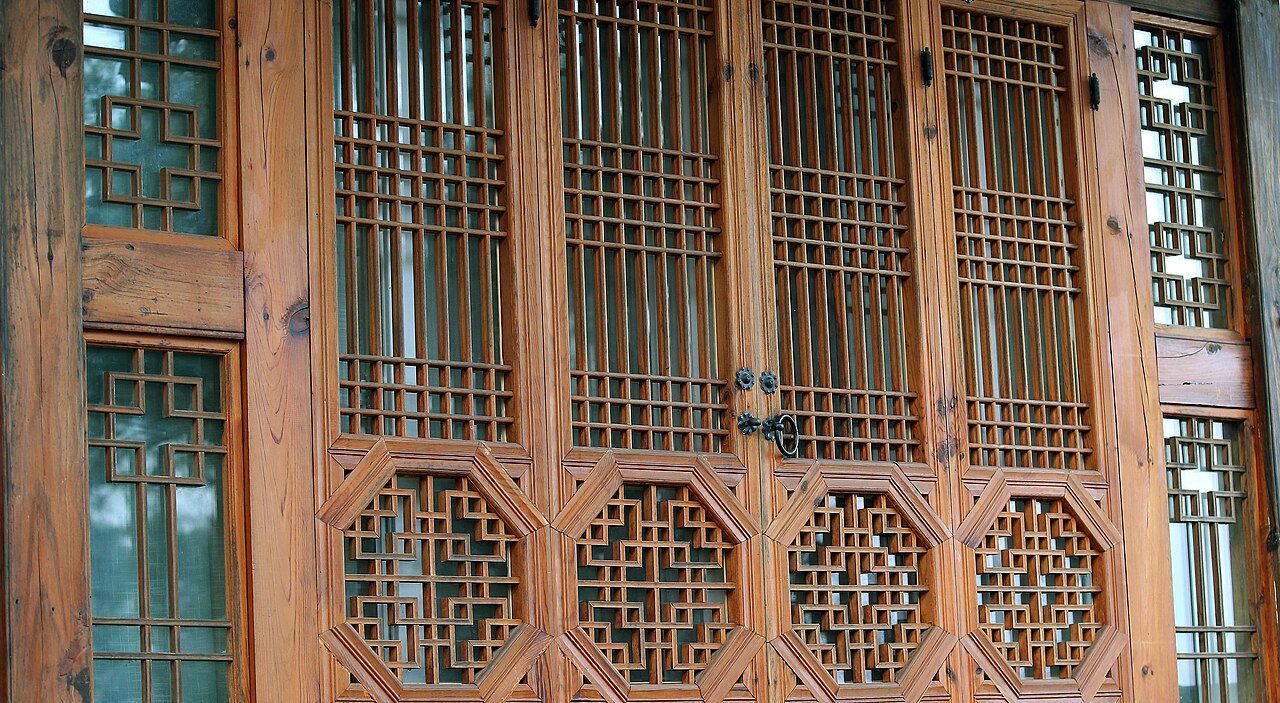
In a hanok the line between door, window and wall is blurred. Most openings are frames of thin wooden bars, covered on one side with paper, and most of them open. The general word for them is changho (창호), a combination of chang (窓), a window, and ho (戶), a door. Lee Wan-geon’s study of traditional house doors notes that Korean doors and windows are often hard to tell apart by shape or size, which is why the single word covers both; from the 17th century, he adds, the ‘ho’ part gradually dropped out of use in favour of mun (문), the everyday word for door.
Paper is the key. Hanji (한지), Korean paper made from the inner bark of the paper mulberry, lets light through softly while keeping wind out. Behind a papered door a room is bright but private, and the shadows of the lattice fall across the paper. It is the single most characteristic sight inside an old Korean house.
The lattice: what the bars are for
A changho door is a light frame filled with sal (살), slender bars. The writer Tim Alper, in the Korean Culture and Information Service’s KOREA magazine, gives them three practical jobs: holding the paper in place, stiffening the frame, and decoration. Joseon houses mostly kept the patterns plain. Confucian taste favoured simple, regular bars; flowered and coloured lattices belong to Buddhist temples, where lotus and flower panels carry religious meaning.
Korean writers name doors by their lattice pattern. Lee lists the main ones: sesal (세살), also called ttisal (띠살), the commonest, with closely spaced vertical bars crossed by bands of horizontal ones at top, middle and bottom; jeongjasal (정자살), a square grid like the character 井; yongjasal (용자살), with a pattern resembling 用; ajasal (아자살), based on 亞; and wanjasal (완자살), a meander based on 卍. There are also panel doors with no lattice at all, panjangmun (판장문), used for kitchens and storerooms.
Hanji, the paper
Hanji is made from dak (닥), the paper mulberry, and the KOREA magazine article describes it as a sturdy bark paper used by scribes and artists as well as builders. The paper made for doors and windows is called changhoji (창호지). It is strong, slightly translucent and porous. An Andong hanji maker quoted in a 2023 newspaper report puts its virtue simply: it lets light and air through but keeps the wind out.
That porosity is why a papered room feels like it breathes, and also why a hanok room is cooler than a modern one in winter. The thin skin of paper is the weakest point in the house’s insulation, which is one reason the doors were renewed every year before the cold.
Re-papering
Paper tears, yellows and loosens, so it is replaced. The newspaper report from Andong describes the custom in old houses there: when the cold wind starts to blow in autumn, the doors get new paper. A freshly papered door is bright white and taut; by the following summer it has softened, and any tears show where hands and elbows have pushed against it.
For visitors the practical point is that the paper is thin. It is easily torn by a finger or a bag, and it carries sound: in a hanok stay you will hear the people in the next room, and they will hear you.
Doors that open a whole wall
Between a room and the daecheong, or along the front of the hall, you will often see a row of tall doors that fold together and then swing up to lie flat against the ceiling. This is deureoyeolgae (들어열개), the ‘lift-up’ door, usually combined with bunhammun (분합문), sets of folding leaves that span a whole bay. The Encyclopedia of Korean Culture’s entry on the maru describes how in summer these doors were taken down or hooked up, blinds were hung, and the hall and rooms became one open, airy space.
With the doors up, a room and the wooden hall merge, and you can see straight through the house to the yard behind. Jung Myung-seop’s study of lift-up doors between hall and room traces a change over time towards lighter, more open types, with slender bars and bright paper. Lee’s survey of houses in Jecheon finds four-leaf lift-up doors on wooden-floored rooms in several houses.
Kinds of opening, kinds of door
Lee classifies changho in several ways at once: by how they open, as swinging doors (yeodaji, 여닫이), sliding doors (midaji, 미닫이) and lift-up doors (deureoyeolgae); by function, with named types of paired outer doors and inner screens; and by position. Openings were often layered, with lattice doors outside and further screens inside; in the Jecheon houses he surveyed, the sarangbang of a gentry house had three layers on one opening.
Many windows sit above a low panelled sill called meoreum (머름). Lee’s survey found meoreum under most of the main-room windows in Jecheon. Combined with life at floor level, the effect is that the window opens at about the height of a seated person’s shoulder.
Light and air
A papered door turns sunlight into an even glow. Because the eaves are deep, direct sun reaches the paper mainly in winter, when it is low, and the shadows of the lattice move across the room through the day. In summer the doors are opened or lifted away and air moves through the whole house. Lee quotes the view that Korean doors and walls do not divide space in the hard way that Western walls do, but soften and filter it, so that the house is, in practice, open throughout.
What to look for
- Lattice patterns: count how many different ones a single house uses
- Rows of doors along the daecheong with hooks above them in the ceiling
- The meoreum sill under a window, at the height of a seated person’s elbow
- Paper strips round door edges, and newer, whiter paper on some doors than others
- Layers: an outer pair of lattice doors with sliding screens inside
Sources
- 제천시 전통주거의 창호 특성에 관한 연구 (Lee Wan-geon), Journal of the Korean Institute of Interior Design 22(4), 2013, KoreaScience (read 15 November 2026)
- The Study on the transition of types of Deul-E-Yul-Gae windows and doors in Korean traditional architecture (Jung Myung-seop, 1996), Journal of the Korean Housing Association, via KoreaScience (read 15 November 2026)
- Art of Detail: Magnificent Munsal (Tim Alper), KOREA magazine, Korean Culture and Information Service (read 15 November 2026)
- [신팔도명물] 경북 안동한지, Jeonbuk Ilbo (from Maeil Shinmun) (read 15 November 2026)
- 마루 (Maru), Encyclopedia of Korean Culture, Academy of Korean Studies (read 15 November 2026)