
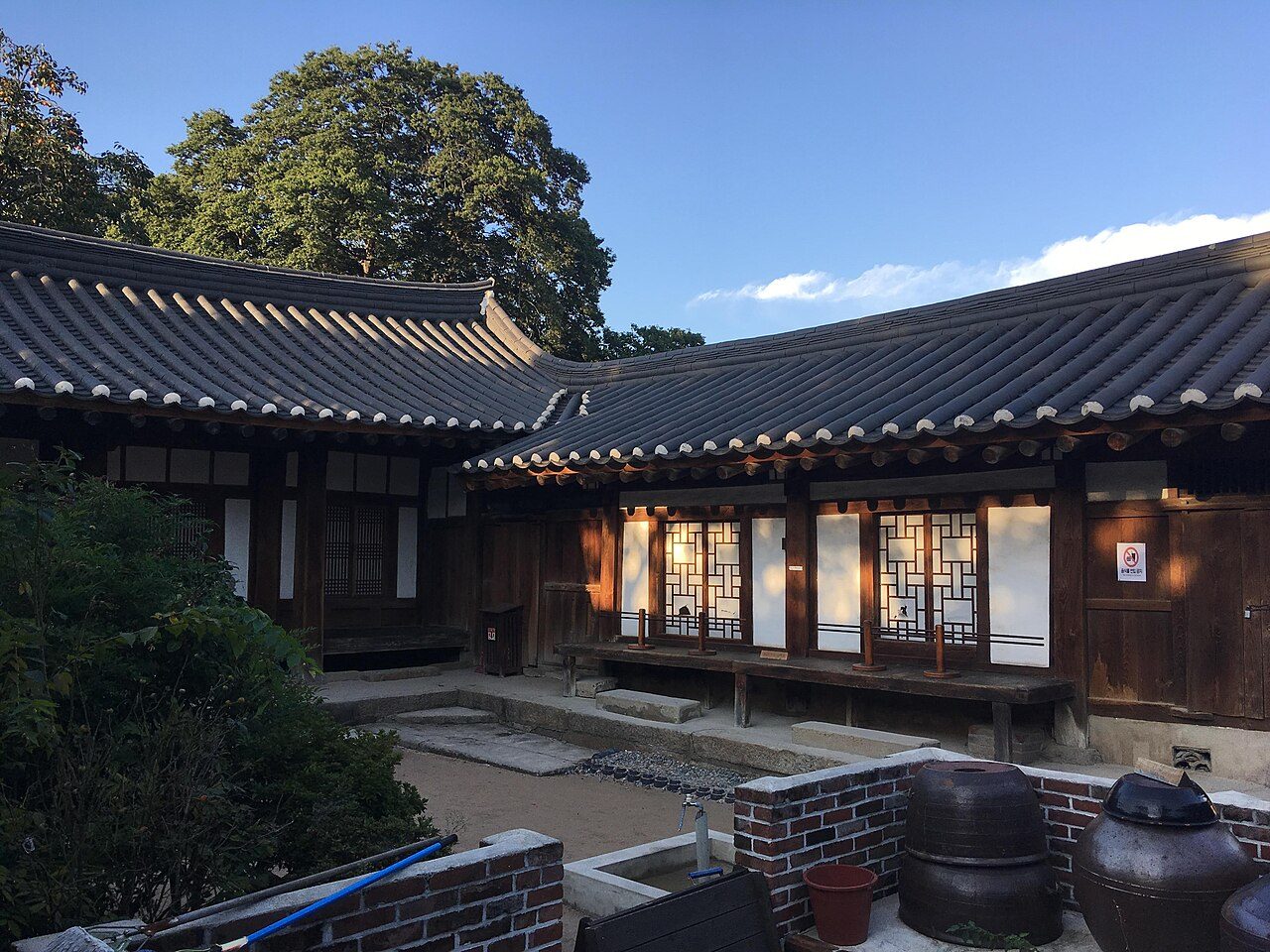

Gyeongsang · Gyeongju, North Gyeongsang · Historic village
Gyeongju Gyochon Traditional Village 경주 교촌마을
Gyeongju Gyochon Maeul
The ‘school village’ beside Gyeongju’s Confucian academy, home of the Choi family famed for generations of wealth and charity.
Overnight staysLived in
Gyochon, ‘school village’, is a small cluster of hanok (한옥) in central Gyeongju, just west of the Silla-era Gyerim woods and north of the Muncheon stream. It takes its name from Gyeongju Hyanggyo, the local Confucian academy, which stands on the site where Silla founded its national academy in 682. Its other anchor is the house of the Gyeongju Choi family, the ‘rich Choi of Gyo-dong’, whose fortune and conduct over many generations are a staple of Korean moral storytelling.
For a visitor interested in houses, Gyochon offers two contrasting types within a few steps of each other: the formal, axial plan of a state Confucian school, with shrine in front and lecture hall behind, and the more relaxed plan of a wealthy family house that grew room by room. It is also an easy add-on to Gyeongju’s Silla sites, which surround it.
What to look at
The Choi family house (Choi Buja-daek) 경주 최부자댁
Enter through the tall sosseul daemun (솟을대문) gate, which Gyeongju City describes as the only one left in Gyochon and a hint of the house’s former scale. The gate wing holds a small room and a very large storehouse, a reminder of where the family’s wealth was kept. The anchae (안채) behind is an open ㅁ shape, with a family shrine to the north-west and a flower garden behind.
Gyeongju Hyanggyo 경주향교
The textbook layout of a large Confucian school: outer gate, spirit gate, shrine hall and lecture hall lined up north-south, with the shrine area in front of the teaching area. The heritage record notes that the whole complex is turned about ten degrees east of due south. Its five-bay lecture hall is described as the largest surviving single-building myeongnyundang outside the guesthouse-type halls of the Seonggyungwan and Naju.
Gyodong Beopju house 경주교동법주
The smaller Choi house, where the family rice wine is brewed with water from the courtyard well. The heritage record describes a two-stage fermentation taking about 100 days.
Woljeonggyo bridge 월정교
At the southern end of the village, a bridge over the stream on the site of the Silla-period Woljeonggyo, whose remains are a Historic Site. Cross it for the view back over Gyochon’s roofs.
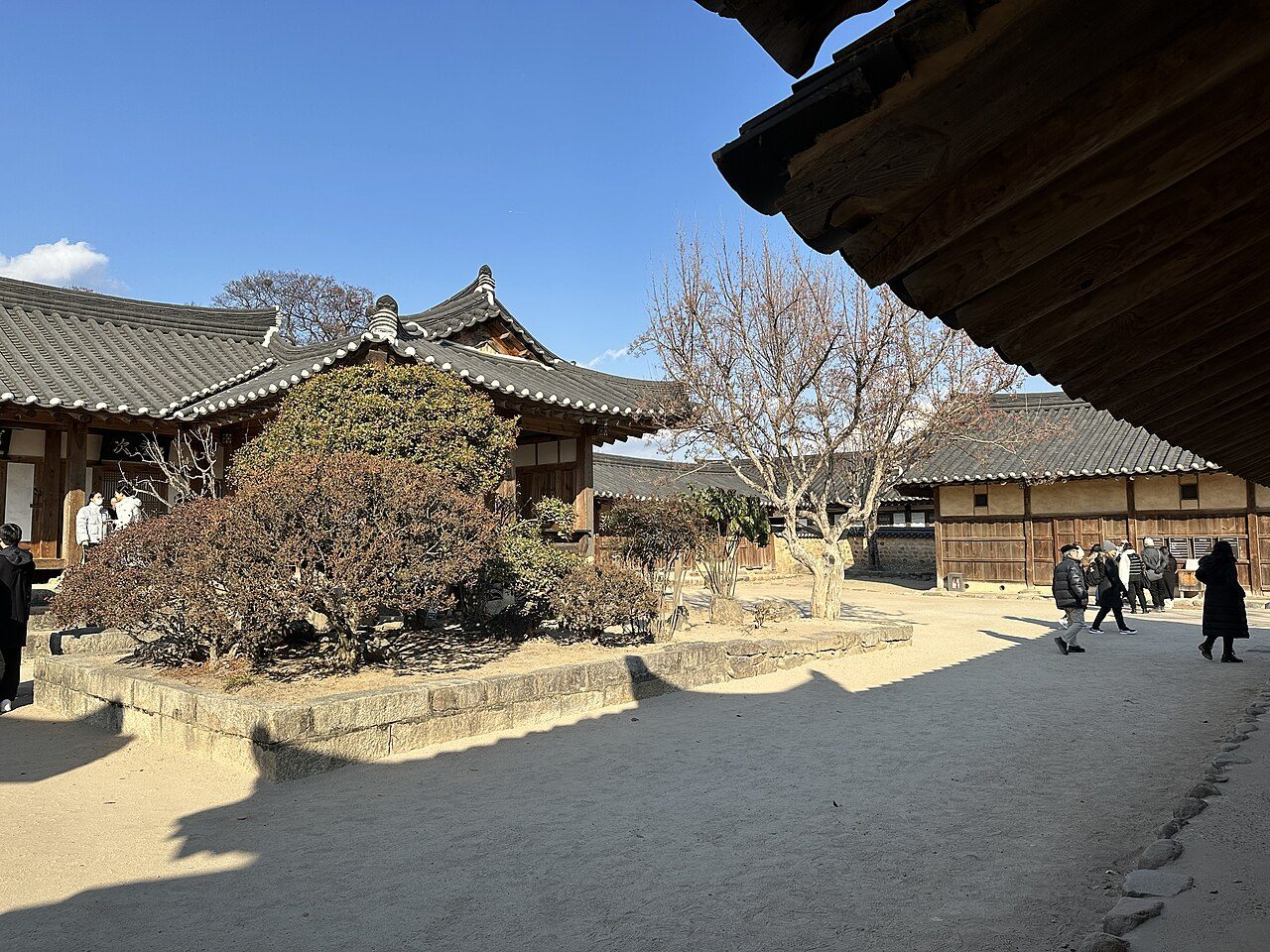

History
Gyeongju Hyanggyo stands on the site of the Silla national academy, founded in 682 under King Sinmun, and later a Goryeo-era school. The Korea Heritage Service records that the Joseon academy was rebuilt in 1492 on the model of the Seonggyungwan in Seoul, burned during the Japanese invasions of the 1590s, and was rebuilt in stages from 1600 to 1614. Its shrine hall (Daeseongjeon) and lecture hall (Myeongnyundang) are both Treasures.
The Choi family moved to Gyo-dong from elsewhere in Gyeongju in the 18th century; Gyeongju City’s webzine dates the main house to around 1779, while the heritage record says only that it is thought to date from about 1700 and that the exact date is unknown. The family is said to have kept its wealth for twelve generations, and is remembered for its rules, among them that no one within a hundred ri should starve and that wealth beyond ten thousand seok of rice should go back to society, and that sons should not seek office above the minor jinsa degree.
On 22 November 1970 a fire destroyed the sarangchae (사랑채) and a separate hall; a contemporary report cited in a 2026 Kyungbuk Ilbo history says 27 of the 47 surviving kan burned. Restoration was completed in 2006, rebuilding the house as it stood just before the fire. The house was designated National Folklore Cultural Heritage in 1971. The family’s Gyodong Beopju, a rice wine first made by Choi Guk-seon, a palace kitchen official under King Sukjong (r. 1674-1720), is a National Intangible Heritage and is still brewed in the smaller family house next door.
Getting there
KTX to Singyeongju Station, city bus 60 or 61 to the Cheonmachong stop, then walk 15-20 min south past Gyerim
Take a KTX to Singyeongju Station. Gyeongju City lists buses 50, 51, 60, 61 and 70 among the routes serving the station; VisitKorea gives buses 60 and 61 to the Cheonmachong (Daereungwon) stop, from where you walk south past Cheomseongdae and the Gyerim woods to Gyochon, about 15-20 minutes.
Route checked 15 November 2026 against: 화려함에 여유로움을 더하다. 경주에서 즐기는 마지막 가을 (VisitKorea Korean edition (Korea Tourism Organization)); 신경주역↔보문단지, 불국사 간 노선버스 신설 (2023) (Gyeongju City). Bus numbers and stops change: check the official page before you set off.
When to go
SpringSummerAutumnWinter
Spring and autumn are the best seasons for combining Gyochon with the surrounding Silla sites on foot. The village lanes are open at all hours, so an early-morning or evening walk avoids the day-trip crowds.
Sources
- Gyeongju Gyochon Traditional Village, VisitKorea (Korea Tourism Organization) (read 15 November 2026)
- 경주 최부자댁, Korea Heritage Service (National Heritage Portal) (read 15 November 2026)
- 경주향교 / 경주향교 대성전 / 경주향교 명륜당, Korea Heritage Service (National Heritage Portal) (read 15 November 2026)
- 경주교동법주, Korea Heritage Service (National Heritage Portal) (read 15 November 2026)
- 교촌마을 (Gyeongju Story webzine vol. 158), Gyeongju City (read 15 November 2026)
- 경주 최부자댁 화재와 복원 (2026-07-23), Kyungbuk Ilbo (kbmaeil.com) (read 15 November 2026)
- 화려함에 여유로움을 더하다. 경주에서 즐기는 마지막 가을, VisitKorea Korean edition (Korea Tourism Organization) (read 15 November 2026)