

Jeolla · Gurye, Jeonnam-Gwangju (formerly South Jeolla Province) · House and estate
Gurye Unjoru Historic House 구례 운조루 고택
Gurye Unjoru Gotaek
A 1776 gentry house sited by pungsu below Jirisan, with a rice chest anyone could open and chimneys kept low out of tact.
Lived in
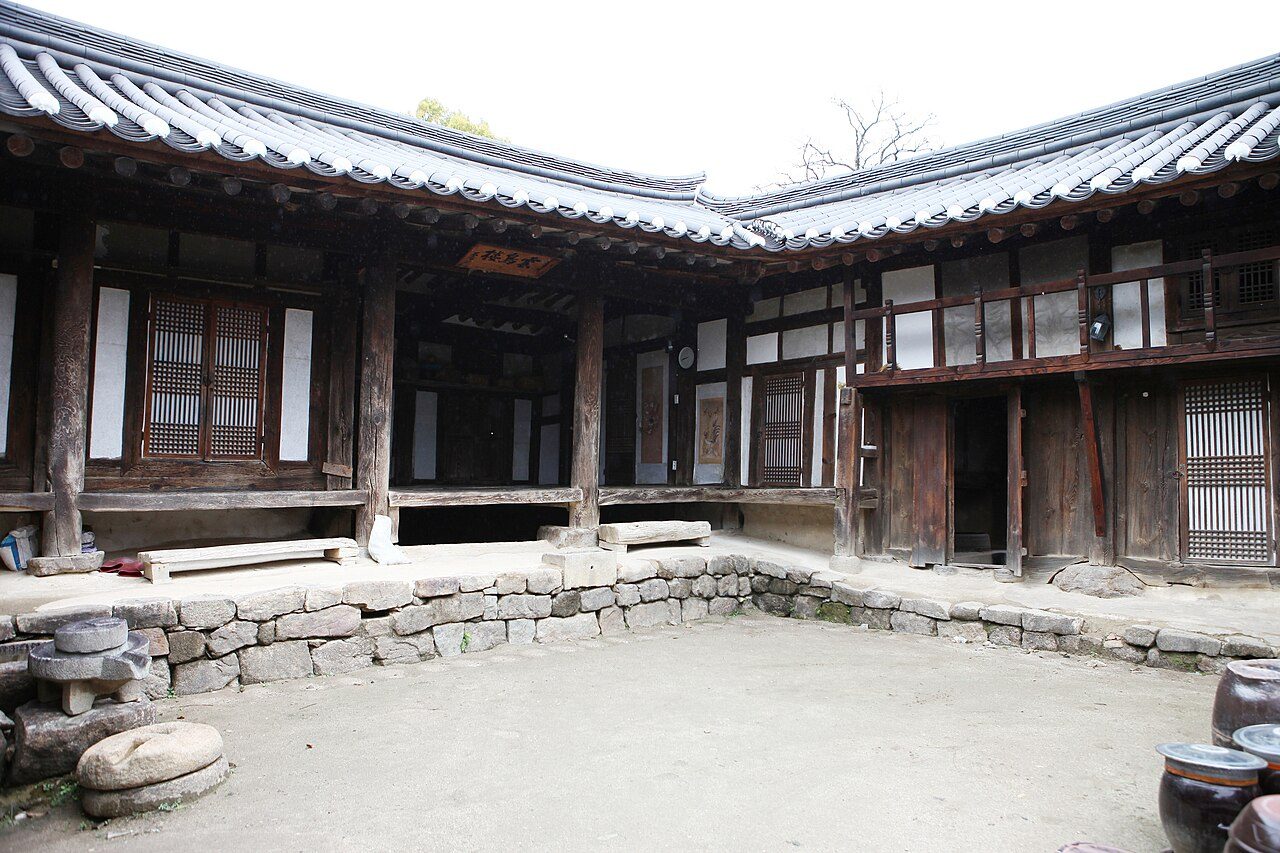
Unjoru is a large yangban (양반) house in Omi-ri, a village at the foot of Jirisan mountain with the Seomjin River valley in front. It was built in 1776 by Ryu I-ju, a military official turned builder, and it is still lived in by his descendants, who show visitors round.
It is the classic Korean example of a house sited by pungsu (풍수), the art of reading land for auspicious placement: mountain behind, water in front. It is also known for something rarer, two details that show a wealthy family thinking about how it looked to hungry neighbours: a rice chest inscribed ‘anyone may open it’ and kitchen chimneys built low so cooking smoke would not advertise the household’s plenty.
What to look at
The tainneunghae rice chest 타인능해 뒤주
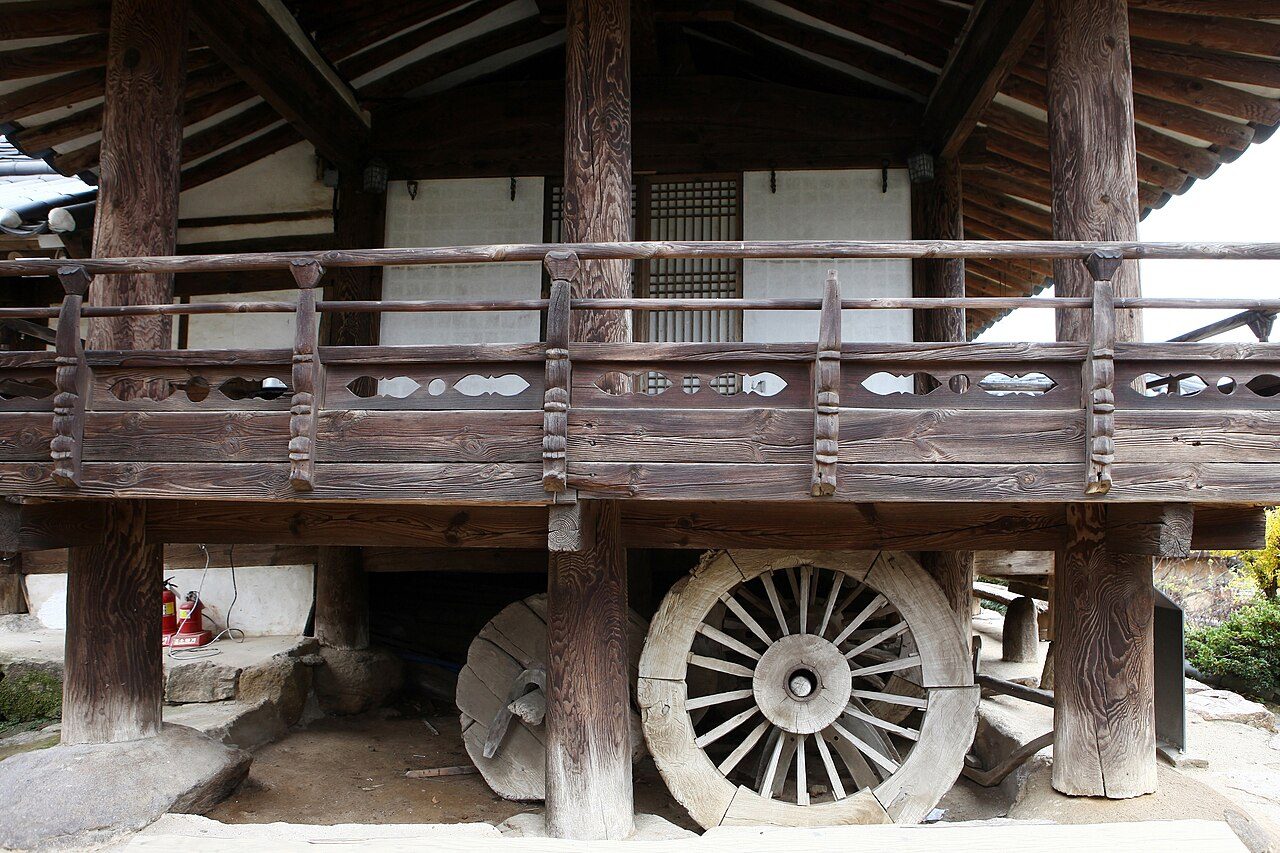
A round wooden rice chest carved with the words tainneunghae (他人能解), ‘anyone may open it’. Turning a wooden peg let rice run out, and accounts say it was placed where the household could not watch who came, so the poor were spared embarrassment; the family is said to have given away about a fifth of its harvest this way. The original chest is shown in the house’s relics exhibition hall.
The low chimneys 굴뚝
Look for the chimneys: rather than rising above the walls, they are kept low, with the outlet hidden under the stone steps, so that cooking smoke stayed close to the ground. Tradition explains it as tact towards neighbours who had nothing to cook.
The sarangchae and its nu-maru 사랑채
The men’s wing is T-shaped, with a raised floor (nu-maru, 누마루) set at right angles so the master could survey the whole household. Its lift-up doors open fully in summer. Unusually, the sarangchae has its own large kitchen, which also serves as a passage to the women’s quarters.
The anchae 안채
The women’s house is larger than the men’s, on an open ㅁ-shaped plan around its own court, raised on high stone steps, with the main hall at the centre and large and small rooms either side. The path up to it under the gate pavilion is a ramp rather than steps.
The gate wing and the view 행랑채
The long servants’ wing runs either side of the gate, part of it raised as a small pavilion. Stand at the gate and look out across the fields towards the Seomjin valley: the open view in front is half of what made the site desirable.

History
Ryu I-ju (1726-1797) was born in Daegu, passed the military examination and spent much of his career on state building works, including fortress projects; the architectural historian Kim Bong-ryeol credits him with designing the house himself, with a nephew supervising construction. Accounts differ on which office led him to Gurye: the Korea Heritage Service calls him a former magistrate of Samsu, while other accounts say he found the site while magistrate of Nagan. The house was completed in 1776. Its name, ‘pavilion of clouds and birds’, is taken from a line of the Chinese poet Tao Yuanming.
The site’s reputation is the stuff of local legend, and should be read as such. The heritage record says the spot, ringed by mountains and a pond, has long been called geumhwan-rakji (금환락지), ‘where the golden ring fell’, and one retelling explains that a fairy bathing here dropped her ring as she rose to heaven. Kim Bong-ryeol records a slightly different tradition, in which Omi-ri holds three auspicious points and Unjoru occupies the one called ‘golden turtle sinking into the mud’, confirmed, the family says, by a turtle-shaped stone dug up during construction. He adds that around 1920 more than a hundred households moved to the village chasing its pungsu, and most soon left.
The family prospered for generations and kept long diaries; land reform after 1945 broke up most of its estate, and the house was later robbed repeatedly as its value became known. It was designated National Folklore Cultural Heritage in 1968. The size is variously given: the heritage record counts 55 kan of timber-framed buildings today, while VisitKorea says 73 of an original 99 kan survive.
Getting there
Gurye Public Bus Terminal, then county bus 4-8 or 4-9 to the Unjoru stop; trains stop at Gurye-gu Station
By rail, KTX and other trains on the Jeolla Line stop at Gurye-gu Station, outside the town; local buses (VisitKorea lists 2-1, 2-5, 2-9 and 2-12) run into Gurye town. From Gurye Public Bus Terminal, county buses 4-8 and 4-9 stop at the Unjoru stop about 40 m from the house; buses 4-2, 4-3, 4-4, 4-5, 4-6 and 4-10 stop at a stop about 500 m away.
Direct express buses also run from Seoul Nambu Terminal to Gurye. These details come from a VisitKorea feature written in October 2023; check locally.
Route checked 15 November 2026 against: 품이 너른 평온한 집, 구례 운조루 (VisitKorea Korean edition (Korea Tourism Organization)). Bus numbers and stops change: check the official page before you set off.
When to go
SpringSummerAutumnWinter
Spring and autumn are the most comfortable seasons. Summer is the time to see the sarangchae doors raised for the breeze. The house is a home, so arrive in opening hours and follow the family’s lead.
Sources
- 구례 운조루 고택, Korea Heritage Service (National Heritage Portal) (read 15 November 2026)
- Gurye Unjoru Historic House, VisitKorea (Korea Tourism Organization) (read 15 November 2026)
- 품이 너른 평온한 집, 구례 운조루, VisitKorea Korean edition (Korea Tourism Organization) (read 15 November 2026)
- 지리산 자락에 터잡고 재력 키운 류씨 가문… ‘조선판 엘도라도’ 꿈꾸다 (Kim Bong-ryeol), Seoul Shinmun (read 15 November 2026)
- 그리운 고향의 옛집, Weekly Kyunghyang (read 15 November 2026)
- [라이프&역사] 타인능해(他人能解)의 땅, 구례, Hangyo (Korea Education Newspaper) (read 15 November 2026)