

Gyeongsang · Andong, North Gyeongsang · Historic village
Hahoe Folk Village 안동 하회마을
Andong Hahoe Maeul
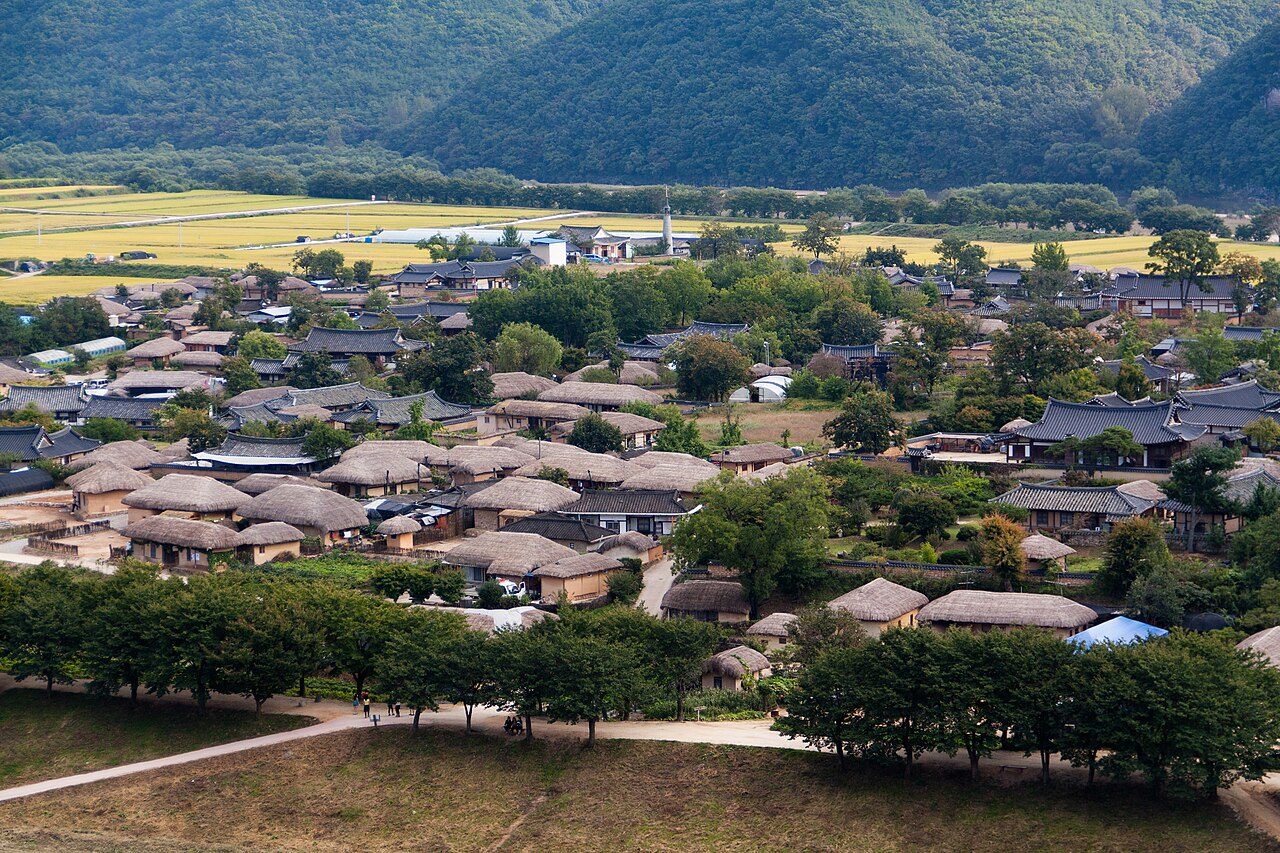
The Pungsan Ryu clan’s village in a loop of the Nakdong: tiled head houses ringed by thatch, all turned to face the river.
UNESCOOvernight staysLived in
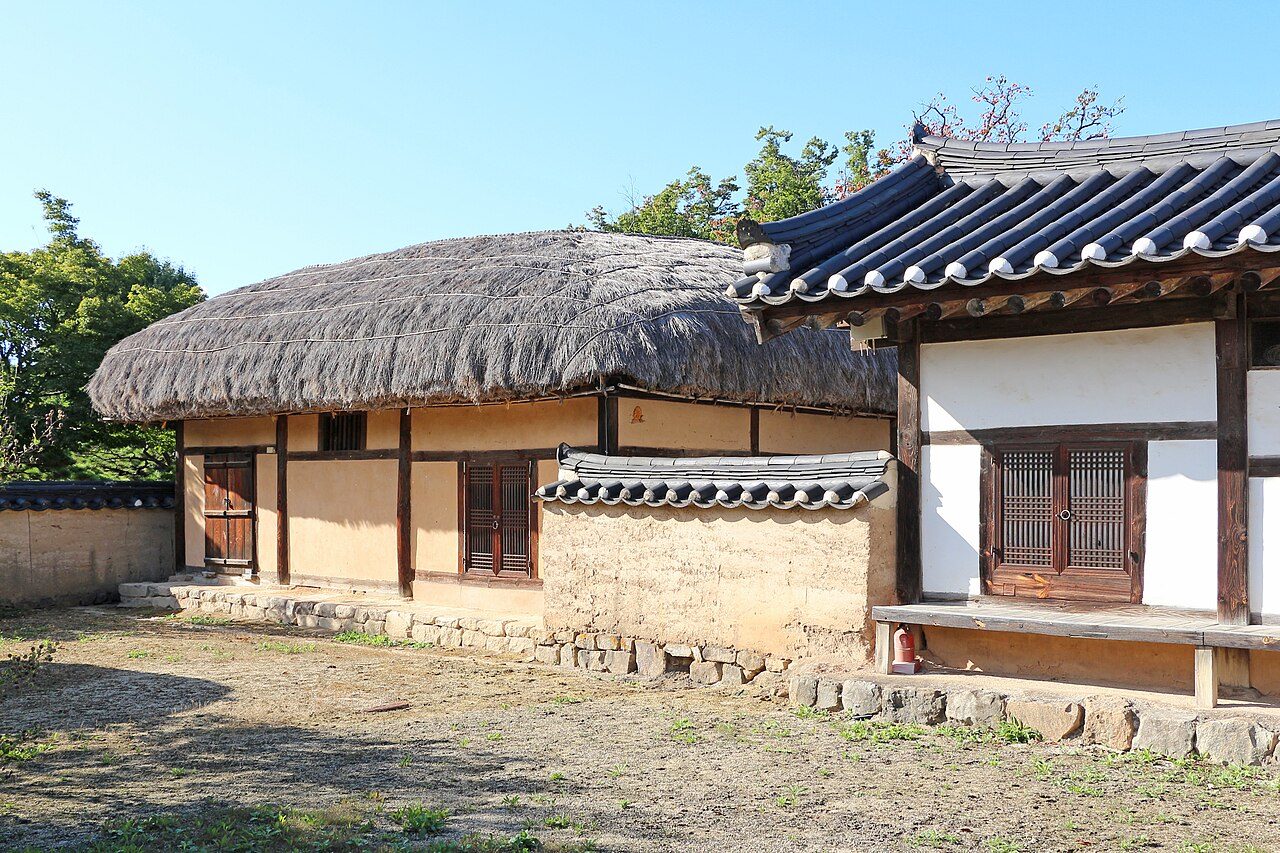
Hahoe is a single-clan village of the Pungsan Ryu, set on a flat peninsula that the Nakdong River wraps around in an S-shaped bend; the name means ‘river turning round’. About 150 households still live here, in a mix of tiled giwa (기와) houses of the clan’s leading lines and choga (초가) thatched houses around them. With Yangdong near Gyeongju, it was inscribed on the UNESCO World Heritage List in 2010 as one of the ‘Historic Villages of Korea’.
The village teaches two things that a single house cannot. First, how a Confucian clan organised space: big head houses (jongtaek) at the centre, smaller tiled houses of branch lines, then thatch, then the fields. Second, how siting worked. Because the land is a near-circle inside the river, the houses do not all face south as Korean houses usually do; the village’s own account notes that they are oriented towards the river, around an old zelkova at the highest point, so their directions vary.
What to look at
Yangjindang 양진당
The head house of the Pungsan Ryu, home of Ryu Un-ryong, with a board naming it after his father Ryu Jung-yeong. The sarangchae (사랑채) is wrapped in a veranda with railings so that it reads almost like a raised pavilion, and its ceiling is left open to the rafters. It is a Treasure.
Chunghyodang 충효당
The house of Ryu Seong-ryong’s line, built by his grandson and enlarged by his great-grandson; the long gate wing was added by an eighth-generation descendant. A ㅁ-shaped anchae (안채) sits behind a straight sarangchae; the hall board was written by the calligrapher Heo Mok. Also a Treasure.
Hwagyeongdang (Bukchon-daek) 화경당 고택
Built in 1862 and among the largest houses here. Its main block is a complete closed ㅁ shape, men’s rooms in front and women’s behind, with the anchae set high on a tall platform. The heritage record notes its main room follows a layout associated with Hamgyeong Province in the far north, an unexpected regional borrowing.
Mansongjeong pine forest 만송정 숲
A belt of pines on the sandbank facing the Buyongdae cliff. The heritage record says Ryu Un-ryong planted ten thousand pines here to soften the energy of the cliff opposite, a pungsu (풍수) remedy turned into a protected Natural Monument.
Buyongdae and Okyeon Jeongsa 부용대
Climb the 64 m Buyongdae cliff across the river: from the top you see the whole S-bend and how the houses turn towards the water. Below it stands Okyeon Jeongsa, the study retreat Ryu Seong-ryong built in 1586.

History
Village tradition holds that the Heo and An families lived here first, a memory kept in the saying ‘Heo laid the ground, An built the gates, the Ryu set the table’ and in the legend that a young man named Heo carved the Hahoe masks. The Pungsan Ryu arrived at the end of the Goryeo period, when Ryu Jong-hye, according to the village’s account, climbed the hill behind the site in drought, flood and fair weather to study water and wind before choosing it. The clan rose through the 16th century and flourished with two brothers: Ryu Un-ryong (1539-1601), a scholar, and Ryu Seong-ryong (1542-1607), chief state councillor during the Japanese invasions of 1592-98 and author of the war memoir ‘Jingbirok’.
In the village’s own count, around 350 households lived here at the end of Joseon; in 1930 there were 158 Ryu and 132 other households in about 300 houses, and in 1963, 266 households with 1,507 people. Today the village counts 127 houses made up of 437 buildings, of which 11 houses are designated heritage. The masks used in the village’s exorcism mask play are National Treasures, thought to date from Goryeo; the Japanese colonial government stopped the play in 1928, and it is now designated National Intangible Heritage.
Hahoe was designated National Folklore Cultural Heritage in January 1984, received Queen Elizabeth II on 21 April 1999, and was inscribed by UNESCO on 31 July 2010, together with Yangdong, as one of the ‘Historic Villages of Korea: Hahoe and Yangdong’. The World Heritage property also includes Byeongsan Seowon, the Confucian academy downriver connected with Ryu Seong-ryong.
Getting there
KTX-Eum to Andong Station, then city bus 210 from the nearby bus terminal to Hahoe, about an hour
Take a KTX-Eum train to Andong Station, which moved in December 2020 to Songhyeon-dong, beside Andong’s bus terminal. City bus 210 runs from downtown via the terminal and Pungsan to Hahoe Village; some runs continue to Byeongsan Seowon. The preservation society’s timetable shows about an hour from downtown to the village and around 13 departures a day.
On weekends and holidays an express bus (Geuphaeng 2) links Hahoe, the terminal and Bongjeongsa temple. VisitKorea lists a shuttle bus among the village facilities. Bus 210 replaced the old route 246 in March 2022, so ignore older guides that give 246.
Route checked 15 November 2026 against: 하회마을 버스번호 및 시간 변경 ‘구 246번’ 2022.3.21 부터 시행 (Andong Hahoe Village Preservation Society); ‘안동역’에서 마지막 열차가 떠났다 (Weekly Kyunghyang). Bus numbers and stops change: check the official page before you set off.
When to go
SpringSummerAutumnWinter
Autumn is the high point: the Andong International Mask Dance Festival runs in late September and early October, with events at Hahoe, and the Seonyu Julbul-nori, fire strung on lines from the Buyongdae cliff over the river, is staged on autumn evenings. Spring is quieter and green. The mask play is performed regularly through the year; check the schedule.
On screen
- Kingdom (2019, drama): Sandbar in front of the Mansongjeong pine wood, Hahoe Village, Andong
Sources
- 안동 하회마을, Korea Heritage Service (National Heritage Portal) (read 15 November 2026)
- 마을의 특징 / 마을역사 / 유네스코 등재, Andong Hahoe Village Preservation Society (read 15 November 2026)
- Andong Hahoe Village [UNESCO World Heritage], VisitKorea (Korea Tourism Organization) (read 15 November 2026)
- 안동 하회 양진당, Korea Heritage Service (National Heritage Portal) (read 15 November 2026)
- 안동 하회 충효당, Korea Heritage Service (National Heritage Portal) (read 15 November 2026)
- 안동 하회마을 화경당 고택, Korea Heritage Service (National Heritage Portal) (read 15 November 2026)
- 안동 하회마을 만송정 숲, Korea Heritage Service (National Heritage Portal) (read 15 November 2026)
- Andong mask dance festival wraps up (2026-10-05), The Herald Business (Herald Corporation) (read 15 November 2026)
- Historic Villages of Korea: Hahoe and Yangdong (World Heritage List), UNESCO World Heritage Centre (read 15 November 2026)