

Gyeonggi · Yongin, Gyeonggi · Open-air museum
Korean Folk Village 한국민속촌
Hanguk Minsokchon
An open-air museum opened in 1974: about 270 relocated and rebuilt houses from across Korea, from thatched farmhouses to a yangban estate.
The Korean Folk Village is an open-air museum, not a historic village. Nobody’s grandparents lived on this spot. From 1973 builders assembled a Joseon-style village south of Seoul out of traditional houses moved from around the country or reconstructed from them, and it opened on 3 October 1974. Today it is run as a commercial attraction with costumed staff, performances, craft workshops and, in a separate zone, fairground rides.
Taken on those terms it is genuinely useful. Nowhere else can you walk from a southern yangban (양반) mansion to a straw-roofed farmhouse with its cowshed, then to a magistrate’s office, in twenty minutes, and see how roofs, room plans and courtyards changed with climate and class. If you want to understand regional house types before travelling to Andong or Jeju, this is a good, if staged, primer.
What to look at
Southern yangban house 남부지방 양반가
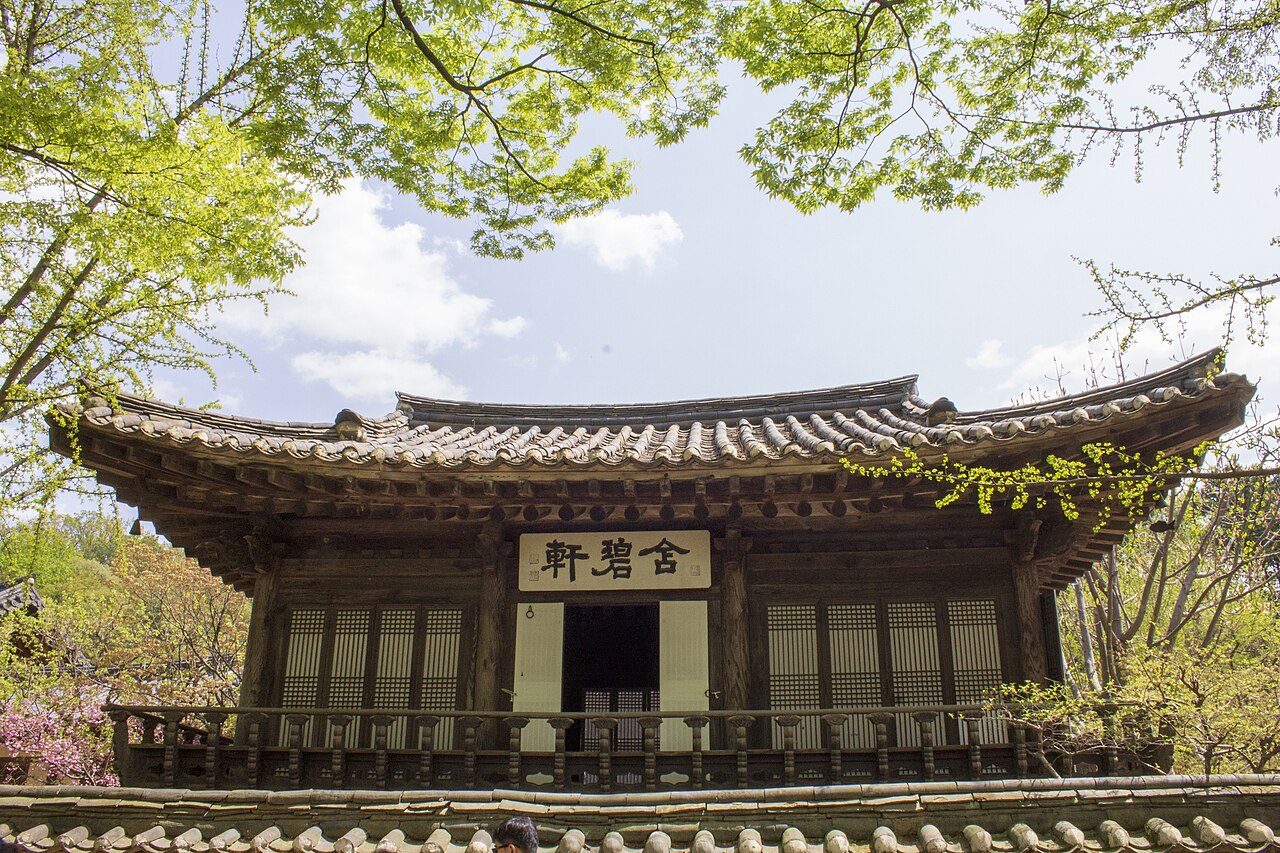
A house of the Honam (Jeolla) type moved to the village, showing a late-Joseon upper-class household. Look for the separation of the men’s sarangchae (사랑채) from the women’s anchae (안채), the raised stone platforms and the walled courtyards, then compare it with the farmhouses nearby.
Thatched farmhouses 초가
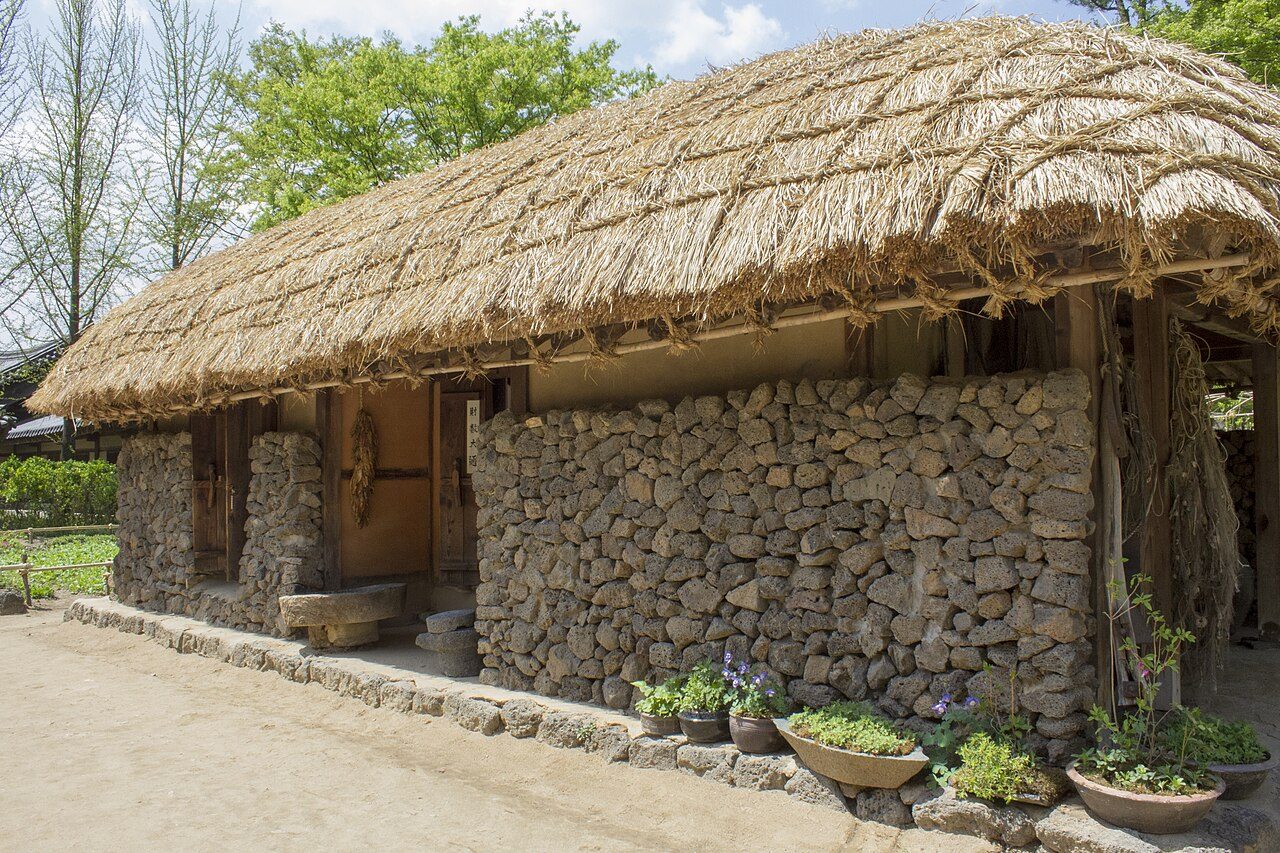
Most buildings here have choga (초가) rice-straw roofs, which is closer to how most Joseon Koreans actually lived than the tiled houses of Bukchon. At one farmhouse a live cow still occupies the shed built into the yard, a reminder that animals, grain and people shared the same compound.
Gwana (government office) 관아
Presented as the office that governed the Yongin area in Joseon times, complete with the frame used for caning offenders; visitors can play clerk or prisoner. Compare its formal courtyard and gate with the domestic compounds around it.
Craft workshops 공방
Working blacksmith, brassware, straw-sandal, mask and dyeing workshops. They are the easiest place to see the tools and materials that went into a traditional house and its furnishings.

History
Planning began in 1972 with an advisory committee for the project; in 1973 a privately financed scheme was approved, and ground was broken on 5 August 1973. According to the National Archives of Korea, the first phase relocated or restored about thirty traditional houses on a site of roughly 660,000 square metres, and the village opened on 3 October 1974. Its stated purposes were preserving folk culture and providing a teaching resource and a tourist attraction.
The site kept growing: a second phase of expansion was completed in 1976, a museum and folk exhibition hall were added in 1996, an amusement park followed in 1997, and further halls were built in the 2000s. The National Archives counts 132 tile-roofed and 143 thatched buildings, matching VisitKorea’s figure of over 270 structures, and some 21,150 folk objects on display.
Because the houses were moved and rebuilt, look at them as specimens rather than as a community: their arrangement is a curator’s choice, not the result of a clan’s history, a river’s course or pungsu (풍수) siting.
Getting there
Suin-Bundang Line to Sanggal Station Exit 3, then city bus 10-5 or 37; or bus 5001-1 from Sinnonhyeon
By subway, take the Suin-Bundang Line to Sanggal Station, leave by Exit 3 and change to city bus 10-5 or 37 for the village. VisitKorea also lists direct buses from Seoul: 5001-1 from Sinnonhyeon Station (Line 9) and 4101 from near Sungnyemun (Seoul Station), and the airport bus A8877 from Incheon International Airport.
Route checked 15 November 2026 against: Korean Folk Village: A Traditional Theme Park Made Even More Captivating with Nighttime Opening (VisitKorea (Korea Tourism Organization)); Korean Folk Village (VisitKorea (Korea Tourism Organization)). Bus numbers and stops change: check the official page before you set off.
When to go
SpringSummerAutumnWinter
Spring and autumn are the most comfortable for a site this spread out. In recent years the village has opened late on Fridays, weekends and holidays through the warmer months, and at Jeongwol Daeboreum, the first full moon of the lunar year (February or March), wishes hung on the village stone tower are burned in a moon-greeting bonfire. School trips crowd weekday mornings in term time.
Sources
- 한국민속촌 (기록으로 만나는 대한민국), National Archives of Korea (read 15 November 2026)
- Korean Folk Village, VisitKorea (Korea Tourism Organization) (read 15 November 2026)
- Korean Folk Village: A Traditional Theme Park Made Even More Captivating with Nighttime Opening, VisitKorea (Korea Tourism Organization) (read 15 November 2026)
- 한국민속촌 (photo feature, 2024-02-04), Segye Ilbo (read 15 November 2026)