
초가 · choga
Choga: the thatched house
Rice-straw roofs renewed every year or two after harvest, mud walls on woven laths, and the roof campaign of the 1970s that ended them.
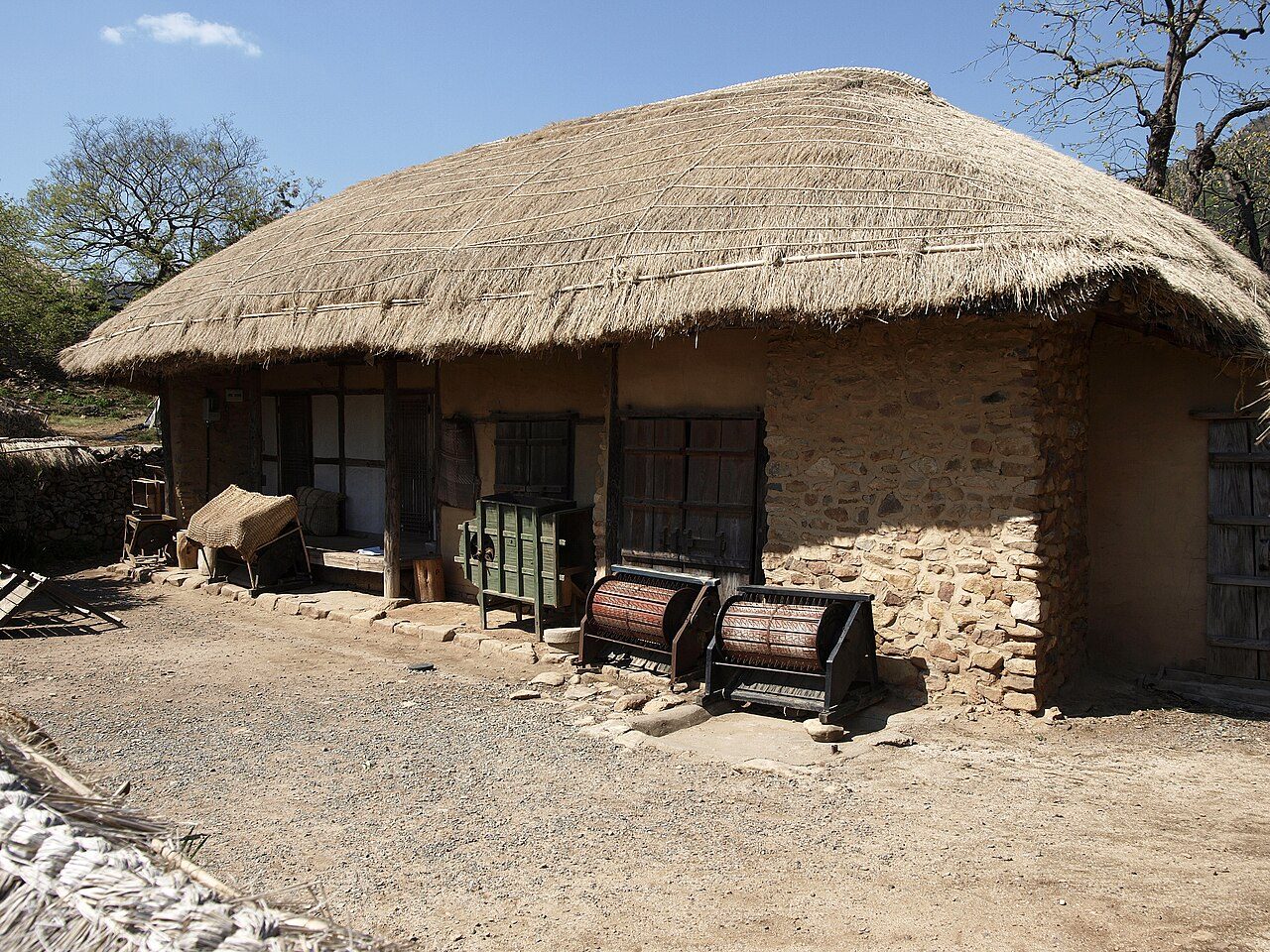
For most of Korean history most Koreans lived under thatch. The choga (초가), the thatched house, was the commoner’s home, as the tiled giwajip was the gentry’s, and the two words were used as a pair. The Encyclopedia of Korean Culture notes that in the Joseon countryside tiled houses usually belonged to the scholar-official class and local elites, and the thatched houses round them to their tenants, stewards and slaves.
Choga are now rare enough to be curiosities. In 1971 the government began a rural roof-improvement campaign that replaced thatch with cement slate and other materials across the country within a few years. What survives is mostly in folk villages and heritage sites, kept up by people who still know how to weave and lay a straw roof.
Straw and other grasses
The Encyclopedia of Korean Culture defines choga broadly: any building roofed with rice straw, reeds, sedge, cogongrass or similar plants, either woven into bundles or laid loose. Rice straw was the usual material because almost every farming household had it after the harvest. The encyclopedia’s entry on thatch explains why grass stems work so well: they are round, straight and smooth, absorb little water, and are hollow, which makes them light and good insulators.
Where other grasses were used, the house had another name. A saetjip (샛집) is roofed with sae (새), a general name for tough grasses such as cogongrass and silver grass; it is found on Ulleungdo and in parts of the mainland. On Jeju the material was cogongrass, tti (띠), cut on the middle slopes of Hallasan.
Weaving and laying the roof
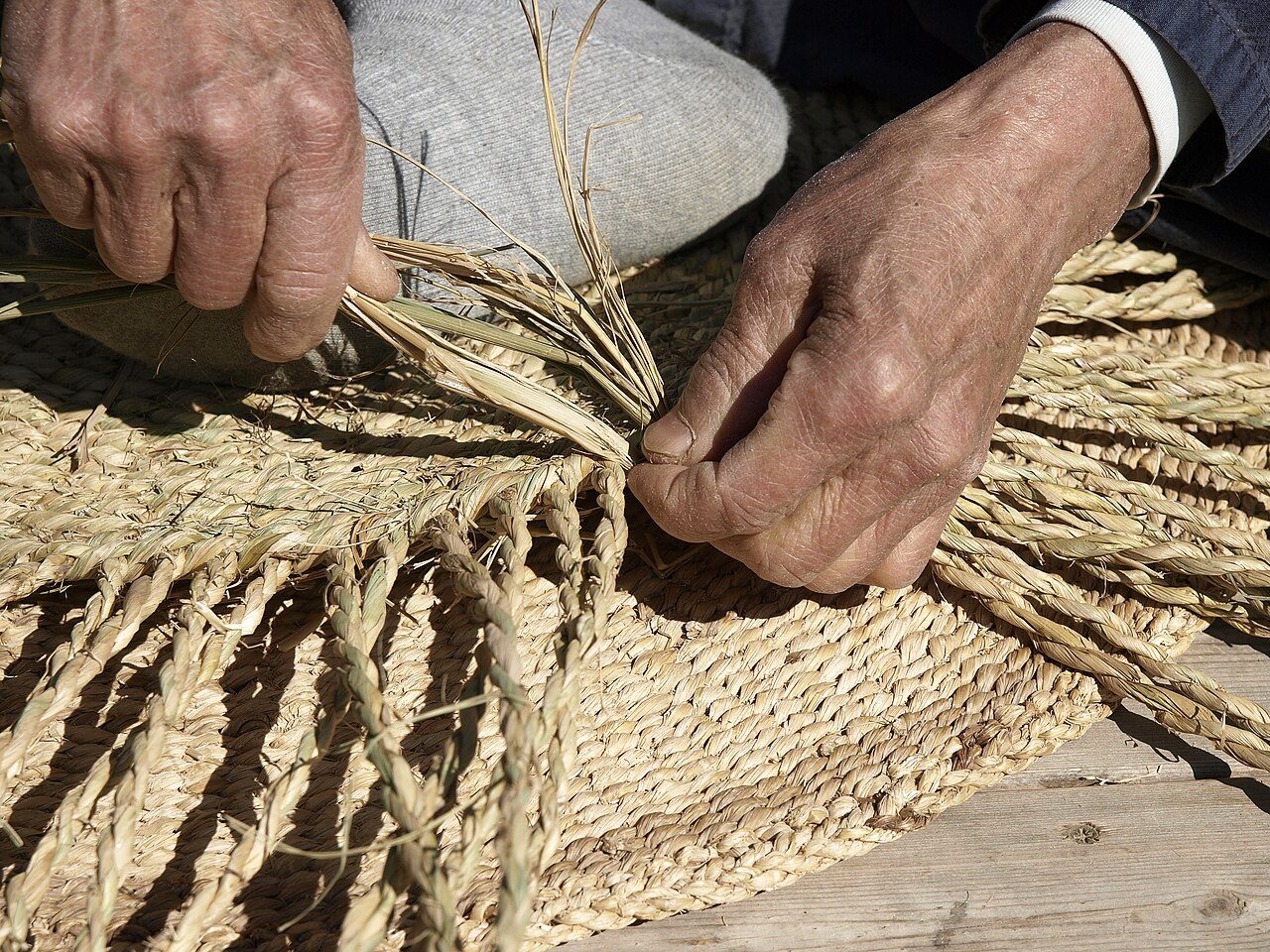
Thatch is first made into ieong (이엉), long woven strips. Handfuls of straw are laid side by side and bound at the base with straw rope into a continuous mat that can be rolled up and carried onto the roof. For the ridge a different piece is made, the yongmareum (용마름), two strips joined at the base into an inverted V that sits astride the top of the roof like a saddle.
Before the first thatching, the roof frame is prepared: rafter ends are tied together with an eave batten, lath or brushwood is laid between the rafters, and mud is spread over it to make a bed. The ieong is laid from the eaves upwards, each course overlapping about a third of the one below, and the yongmareum caps the join at the top. Then the whole roof is tied down under straw ropes stretched across it, and in windy places stones are hung from the ropes at the eaves.
The encyclopedia describes two ways of laying. In one, the scale method, the bundled ends stick out a hand’s breadth like fish scales and the roof lasts longer. In the other, the chain method, smooth rolls are unrolled across the roof like a mat. Korean thatchers traditionally left the grain-heads hanging in a soft wavy line at the eaves rather than cutting them straight, a detail the encyclopedia singles out as distinctive.

A new roof every year or two
Straw rots. The Encyclopedia of Korean Culture says a fresh layer of ieong was usually laid every one to two years, in late autumn once the harvest was in and new straw was plentiful. The work of weaving the strips, carrying them up and tying the roof down again came round as regularly as the harvest itself.
Work songs went with it in some places; on Jeju, a song sung while twisting the roof ropes survives in one village, as the Jeju page describes. The constant upkeep is part of why thatch gave way so quickly once an alternative was offered, and it is why a well-kept choga today represents real, recurring effort.
Mud walls on woven laths
A choga’s walls are timber and earth. Between the posts, small upright sticks called junggit (중깃) are set into the frame; thin laths called oe (외) are woven across them and tied with straw rope; then mud is pressed onto both sides and smoothed. Lee Seung-hwan and Jang Hun-deok’s study of Joseon construction records shows the traditional laths were of brushwood such as bush clover, and argues that the bamboo laths often used in modern repairs came in with Japanese building practice in the modern period.
The result is thick, cheap and repairable, and a mud wall can be patched with the same earth it was made from.
The roof campaign of the 1970s
The Saemaul Undong (새마을운동), the New Village Movement, began in the early 1970s as a government-backed drive to modernise the countryside. National Archives of Korea material describes how villages widened their lanes and replaced roofs and walls, with residents doing the work and the state supplying some of the materials, and notes that thatch made up most rural roofs at the time. The Encyclopedia of Korean Culture dates the roof-improvement project to 1971 and says thatch was replaced mostly with cement slate, often painted.
The archives describe thatch giving way to tile and slate roofs through the movement. The encyclopedia’s author is critical of what came with it, describing government-led rural housing that copied foreign forms and ignored Korea’s climate and ways of living, and calling for new houses that keep traditional values.
Where to see choga now
The surviving groups of thatched houses are mostly in places protected as heritage before or soon after the roofs could be changed. The encyclopedia illustrates its entry with choga at Naganeupseong in Suncheon and at Seongeup on Jeju, both walled settlements whose streets of thatched houses are lived in and maintained. Hahoe and Yangdong mix thatched houses with tiled ones, and the Korean Folk Village in Yongin shows thatched houses alongside its tiled ones. Late autumn, when re-thatching traditionally happened, is the time to see roofs freshly done.
What to look for
- The woven straw ridge cap riding along the top of the roof
- The rope net across the thatch, and any stones tied at the eaves
- The soft, uneven eave line where straw ends hang down
- Cracks where mud wall meets wooden post
- How fresh the straw is: golden after re-thatching, grey-brown a year later
Sources
- 초가 (Choga), Encyclopedia of Korean Culture, Academy of Korean Studies (read 15 November 2026)
- 이엉 (Ieong), Encyclopedia of Korean Culture, Academy of Korean Studies (read 15 November 2026)
- 조선시대 관영건축의 벽체에 사용된 중깃과 외엮기 기법에 대한 연구 (Lee and Jang), Journal of Architectural History 28(4), 2019, Korean Association of Architectural History, via KoreaScience (read 15 November 2026)
- 주거 문화 이야기 (Housing culture), Saemaul roof improvement, National Archives of Korea (read 15 November 2026)
- 집줄 놓는 노래 (Song for laying the roof ropes), Encyclopedia of Korean Culture, Academy of Korean Studies (read 15 November 2026)