

Jeju · Pyoseon-myeon, Seogwipo, Jeju · Historic village
Seongeup Folk Village 제주 성읍마을
Jeju Seongeup Maeul
Jeju’s old county seat: thatched houses roped down against the wind, basalt walls, curving olle lanes and jeongnang gate poles.
Lived in
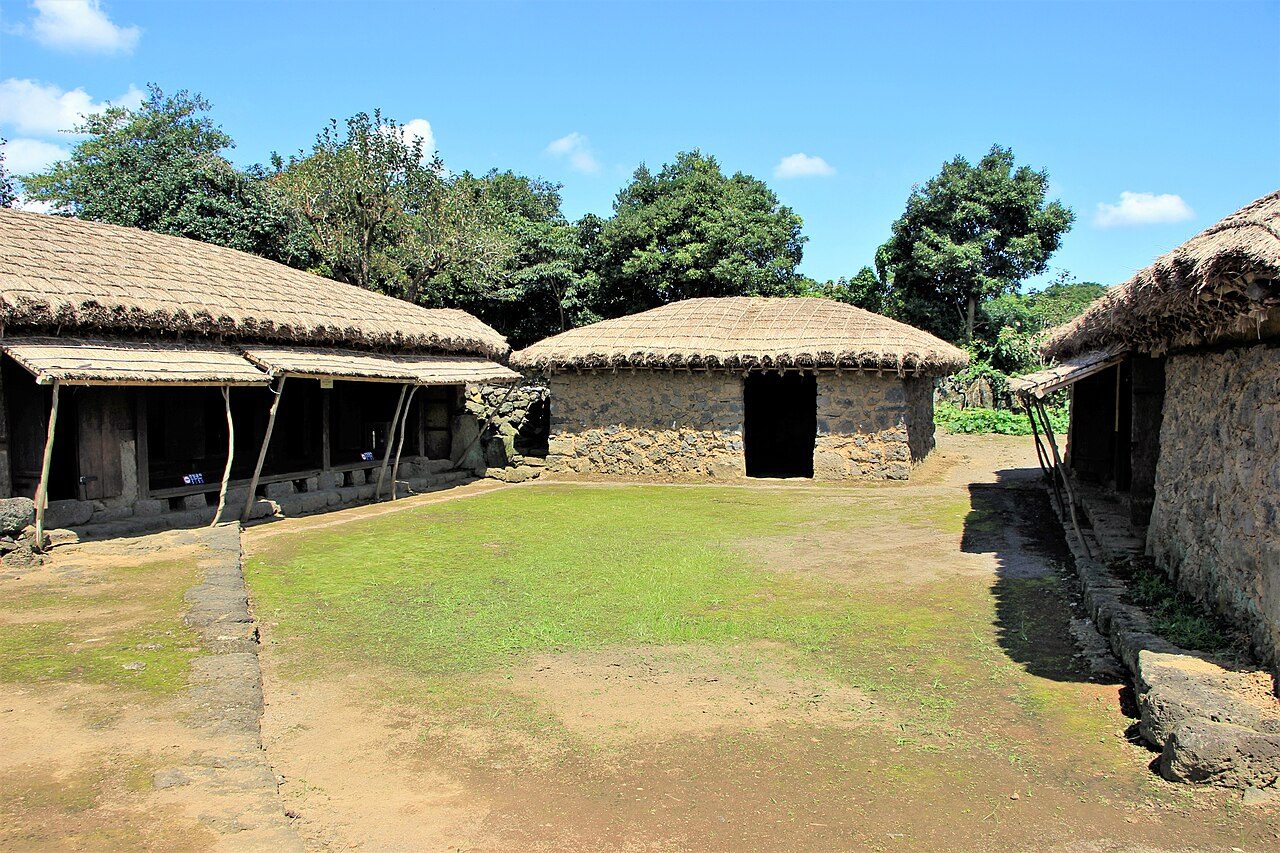
Seongeup was for centuries the seat of Jeongui county in eastern Jeju, an inland village ringed by hills. Today it is a lived-in village where residents keep the island’s distinctive houses: low, thatched, one-row buildings behind stone walls, reached by winding lanes. The whole village is National Folklore Cultural Heritage.
Jeju houses answer different problems from mainland hanok (한옥): strong wind and a farming life built around free-ranging cattle and horses. So the roofs are low and netted down with rope, walls are of piled stone, there is usually no gate at all, and two separate households often share one yard. Seongeup is the best place to see all of this in its own setting rather than in a museum.
What to look at
Jeongnang gates 정낭
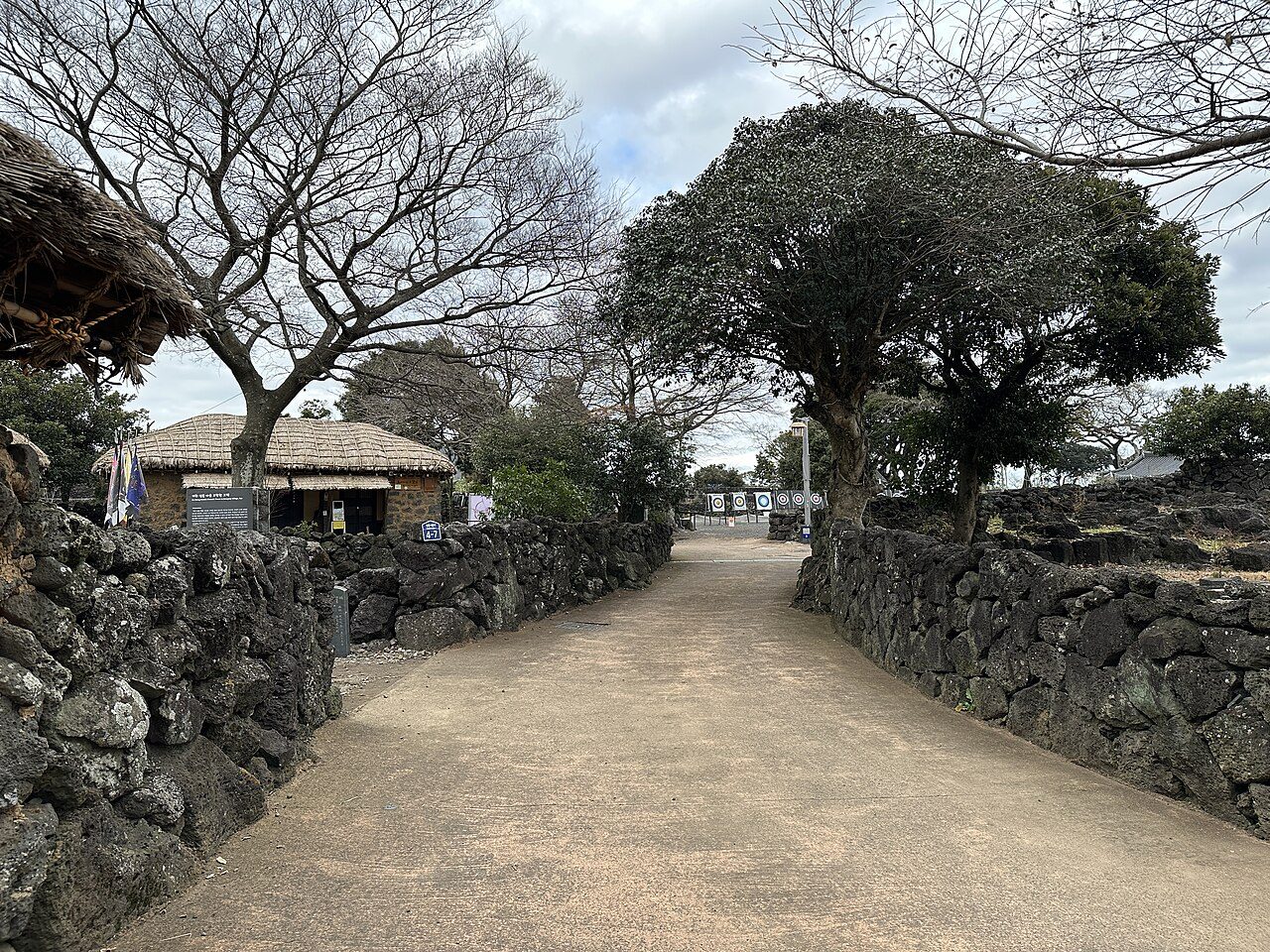
Jeju houses had no gate. Instead, two posts (jeongjumok, or jeongjuseok when made of stone) stand at the end of the entry lane, with holes for usually three wooden poles. According to the Digital Seogwipo Culture Encyclopedia, all three poles up meant the owner was away on a long trip, one up meant they had gone nearby, and none meant someone was home; the poles also kept wandering cattle out.
Olle lanes and stone walls 올레와 돌담
The olle (올레) is the narrow, curving lane from the road to a house yard, shaped so that the house cannot be seen from outside. It replaced the mainland gate as the line between public and private. Look at the high stone walls along it.
Gaekju-jip (the inn) 객주집
A late-18th-century inn whose buildings, the inner house (angeori), outer house (bakkeori), storehouse, gate house and a side building, surround the yard. All the roofs are netted with straw rope so the wind cannot strip them. The inner house is the classic Jeju three-bay plan: central hall, kitchen and small room on one side, main room and grain store (gopang) on the other.
Angeori and bakkeori 안거리와 밖거리
Most houses here pair two straight, one-row buildings across a yard: an inner house and an outer house. The Digital Jeju Culture Encyclopedia explains that the two households living in them ran separate economies while sharing the yard; ancestral rites were held only in the inner house.
Ilgwanheon and the old trees 일관헌
The restored office of the Jeongui county magistrate, with square pillars and a hipped-and-gabled roof, under the millennium-old zelkova and hackberries. Compare its tiled roof with the thatch around it to see where the state stood in the village.

History
In 1416, on a proposal by the official O Sik, Jeju was divided into three administrative districts, and the island was governed that way for about five centuries. Seongeup became the seat of Jeongui-hyeon in 1423, after the county office was moved here from a site exposed to raids by Japanese pirates. The Korea Heritage Service notes the oddity of a mountain village serving as a county town: its government office, Confucian school and inn all stand among farmhouses.
The county office, Ilgwanheon, has been restored on its old site among ancient trees. The great zelkova beside it is estimated at about 1,000 years old, and records suggest trees grew here as early as the late 13th century; the zelkova and the surrounding hackberries are a Natural Monument, and villagers treat the grove as sacred. Jeongui Hyanggyo, the local Confucian school, was first built in 1423 elsewhere and moved here in 1849.
Seongeup was designated National Folklore Cultural Heritage in 1984. Several houses are designated individually, including the Gaekju-jip, an inn near the old guesthouse for officials, built in the late 18th century.
Getting there
Jeju city bus 221 or 222 from Jeju Bus Terminal towards Pyoseon, via Bonggae and Daecheon-dong to Seongeup
From Jeju International Airport or Jeju city, go to Jeju Bus Terminal and take bus 221 or 222, which run via Donggwangyang, Bonggae and Daecheon-dong to Seongeup and on to Pyoseon. The Jeju provincial bus information system lists both routes; check its timetable for departures.
From Seogwipo or the Pyoseon coast, the same routes run inland from Pyoseon to Seongeup.
Route checked 15 November 2026 against: 221 / 222 노선 시간표 (Jeju Special Self-Governing Province Bus Information System). Bus numbers and stops change: check the official page before you set off.
When to go
SpringSummerAutumnWinter
Spring and autumn are the most comfortable seasons, and VisitKorea notes that the village holds cultural events every October and November. A windy winter day shows why the roofs are roped down.
Sources
- 제주 성읍마을, Korea Heritage Service (National Heritage Portal) (read 15 November 2026)
- 제주 성읍마을 객주집, Korea Heritage Service (National Heritage Portal) (read 15 November 2026)
- Seongeup Folk Village, VisitKorea (Korea Tourism Organization) (read 15 November 2026)
- Seongeup Village, Visit Jeju (Jeju Tourism Organization) (read 15 November 2026)
- 정낭, Digital Seogwipo Culture Encyclopedia (Academy of Korean Studies) (read 15 November 2026)
- 주생활, Digital Jeju Culture Encyclopedia (Academy of Korean Studies) (read 15 November 2026)
- 221 / 222 노선 시간표, Jeju Special Self-Governing Province Bus Information System (read 15 November 2026)
- 제주 성읍리 느티나무 및 팽나무 군, Korea Heritage Service (National Heritage Portal) (read 15 November 2026)
- 일관헌, Korea Heritage Service (National Heritage Portal) (read 15 November 2026)
- 정의향교, Korea Heritage Service (National Heritage Portal) (read 15 November 2026)