
제주 민가 · jeju minga
Jeju stone houses
Black stone walls, low thatch roped down against the wind, a gate of three poles, and two houses in one yard for two generations.
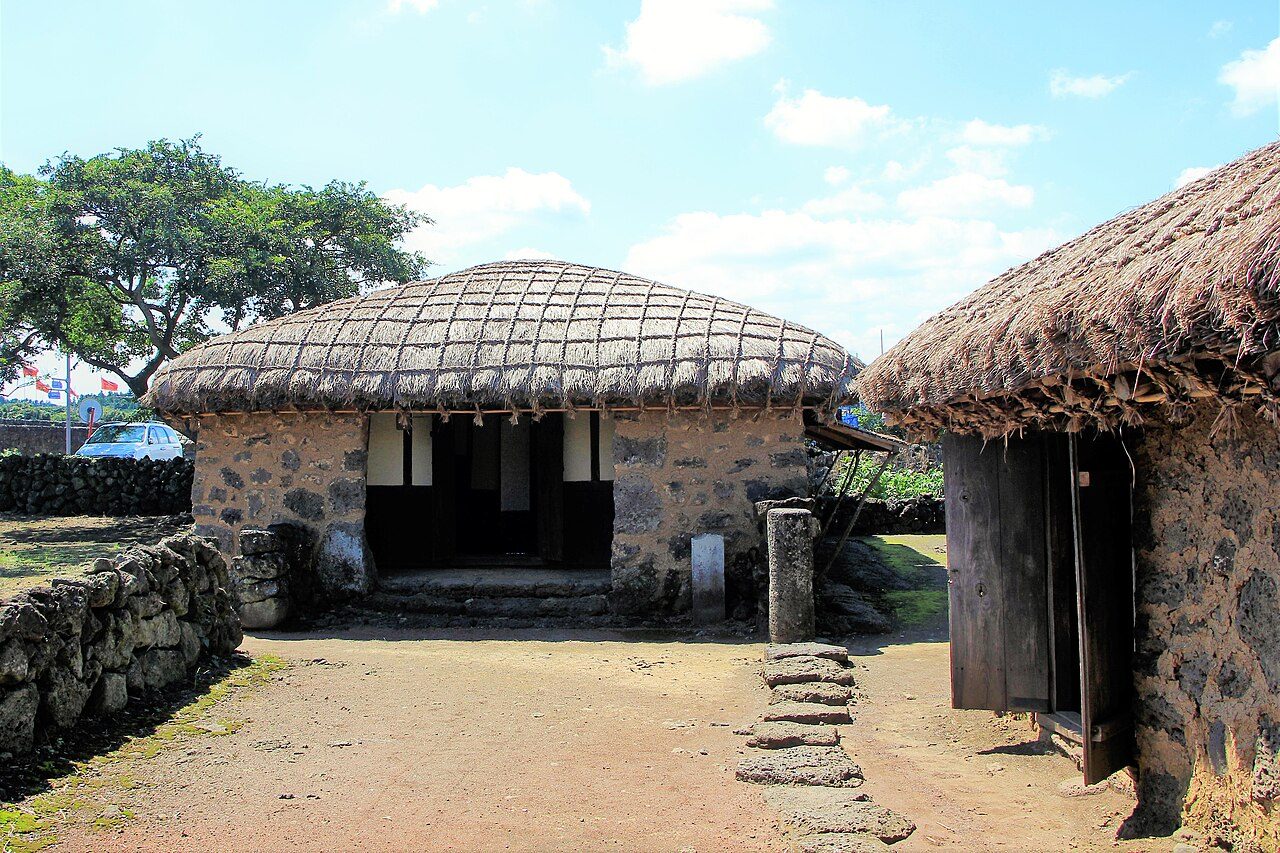
Jeju’s traditional houses look like nothing on the mainland. They sit low behind walls of dark volcanic stone, under rounded roofs of grass thatch held down by a net of rope. There is often no gate at all, only a pair of stone or wooden posts with holes for poles. And a single yard usually holds not one house but two: one for the parents, one for a married son and his family, each running its own kitchen.
Almost every one of those features is an answer to the island’s conditions. Kim Ki-deog and Lee Seung-ho’s study of Jeju folk houses and climate finds double-row room plans, low eaves, gently pitched roofs and stone walls across the whole island, and links them to the wind, with the strong north-westerly winter monsoon shaping houses on the north coast most.
Stone, earth and a roof tied down
The outer walls of a traditional Jeju house, and the walls round its yard and fields, are built of the island’s dark volcanic stone; gateposts of basalt are standard enough that the stone version has its own name, as described below. Stone walls of this kind appear across the whole island in the climate study’s survey.
The roof is thatched with tti (띠), cogongrass, which the Encyclopedia of Korean Culture says was cut on the middle slopes of Hallasan, rather than with rice straw. Unlike mainland thatch, it is spread loose instead of being woven into strips. It is then tied down under ropes of the same grass pulled tight lengthwise and crosswise into a grid like a go board, a sight the encyclopedia calls unique to Jeju. The roof is low and gently pitched, with low eaves, the shape the climate study links to wind. In the village of Deoksu-ri, where gusts off Sanbangsan mountain hit especially hard, the work of twisting the ropes had its own song, ‘Jipjul noneun norae’ (집줄 놓는 노래), sung in call and response while two strands were plaited into one.
The olle and the gate of poles
A Jeju house is reached by an olle (올레), a narrow lane walled with stone that leads from the village street to the yard. Jeju homes once planted flowers along it, Kim Yu-jeong of the Jeju Culture Research Institute notes.
Where the olle meets the street there is usually no door, only the jeongnang (정낭): up to three wooden poles laid across the entrance, their ends resting in holes in a pair of posts. Posts of stone are jeongjuseok (정주석); posts of wood are jeongjumok (정주목). Jin Gwan-hun of the Jeju Cultural Heritage Research Institute explains that the poles mainly kept cattle and horses out: Jeju had no tigers or wolves to guard against, so a full gate was unnecessary. The poles also signalled to neighbours whether the family was at home and roughly how long they would be gone. Accounts of exactly what each arrangement meant differ, but they agree that all three poles in place meant nobody was in.
Islanders liked to say that Jeju had three things it lacked: thieves, beggars and gates. Jin notes that the saying is old and widely believed, while the reasons offered for it, from close-knit villages to the difficulty of escaping an island with stolen goods, are anyone’s guess. Not every house made do with poles: wealthier households and those in busier towns built a proper gate building, the imungan (이문간).
Angeori and bakgeori: two households, one yard
The most distinctive thing about a Jeju homestead is its pair of houses. The angeori (안거리), the inner house, is the main dwelling; facing it across the yard stands the bakgeori (밖거리), the outer house, of similar plan. Some homesteads add a third building, the mokeori (모커리), at the side.
Hong Kwang-taik and Park Chung-keun describe this as the basic layout of the Jeju traditional house: within one enclosure, two buildings of similar size house two generations, parents and a married son, who keep separate household budgets and run their affairs separately. The generations share a yard and a wall, but not a purse.
Inside the house
A Jeju house is usually three or four kan long. At its centre is the sangbang (상방), the wooden-floored hall that the mainland calls maru, used for meals, guests and ancestral rites. The encyclopedia’s entry on the maru notes that on Jeju this floored room long remained the main living space. On either side are rooms, a kitchen called jeongji (정지) and a storeroom, the gopang (고팡), for grain and jars, kept locked and sometimes home to a household spirit.
Heating came late. The Encyclopedia of Korean Culture cites the 17th-century official Yi Hyeong-sang, who recorded that Jeju commoners’ houses had no heated floors, and the scholar Yi Ik, who noted that by his day some had begun to heat one room. When heated floors did arrive, rooms away from the kitchen were warmed by a separate fire pit called the gulmuk (굴묵), fed with fuel such as barley husks and animal dung.
The yard and its corners
Round the houses lay the working parts of the homestead: a kitchen garden, the uyeong (우영), for greens, onions and peppers; sheds for tools and cattle; and the tongsi (통시), the pigsty that was also the toilet, set on the side away from the kitchen. Kim Yu-jeong lists camellia, persimmon, loquat and peach among the trees planted inside the enclosure, with a fig beside the pigsty.
Where to see them
Seongeup, the administrative seat of Jeongui county in the Joseon era, was designated national folk heritage in 1984. It keeps black stone walls, thatched houses and government buildings together, and its houses are still lived in, which makes it the best place on the island to walk an olle and see a jeongnang in use. Treat it as a village, not a museum: knock or ask before going past the poles.
What to look for
- The grid of rope over the thatch and how low the roof sits
- The jeongnang posts at the end of the olle, and how many poles are across
- Two houses facing each other across one yard
- Small fire openings on the outside of rooms not next to the kitchen: the gulmuk
Sources
- The characteristics of folk house related to climate in Cheju island (Kim and Lee, 2001), Journal of the Korean Association of Regional Geographers, via KoreaScience (read 15 November 2026)
- 제주지역 현대건축의 배치계획특성에 관한 연구 (Hong and Park), Journal of the Korean Institute of Rural Architecture 12(2), 2010, KoreaScience (read 15 November 2026)
- 집줄 놓는 노래 (Song for laying the roof ropes), Encyclopedia of Korean Culture, Academy of Korean Studies (read 15 November 2026)
- 이엉 (Ieong), Encyclopedia of Korean Culture, Academy of Korean Studies (read 15 November 2026)
- 구들 (Gudeul), Encyclopedia of Korean Culture, Academy of Korean Studies (read 15 November 2026)
- 마루 (Maru), Encyclopedia of Korean Culture, Academy of Korean Studies (read 15 November 2026)
- 도둑 없던 제주, 집주인 출타 알리는 ‘정낭’만 있었다 (Jin Gwan-hun), Jnuri (read 15 November 2026)
- 우잣 공간의 구조 (Kim Yu-jeong), Jnuri (read 15 November 2026)
- Seongeup Folk Village report (Hwang Joo-young), The Korea Herald (read 15 November 2026)