

Gangwon · Gangneung, Gangwon State · House and estate
Seongyojang House 강릉 선교장
Gangneung Seongyojang
A Gangneung gentry estate that grew for two centuries: low women’s house, high men’s hall, lotus-pond pavilion and a hanok stay.
Overnight staysLived in
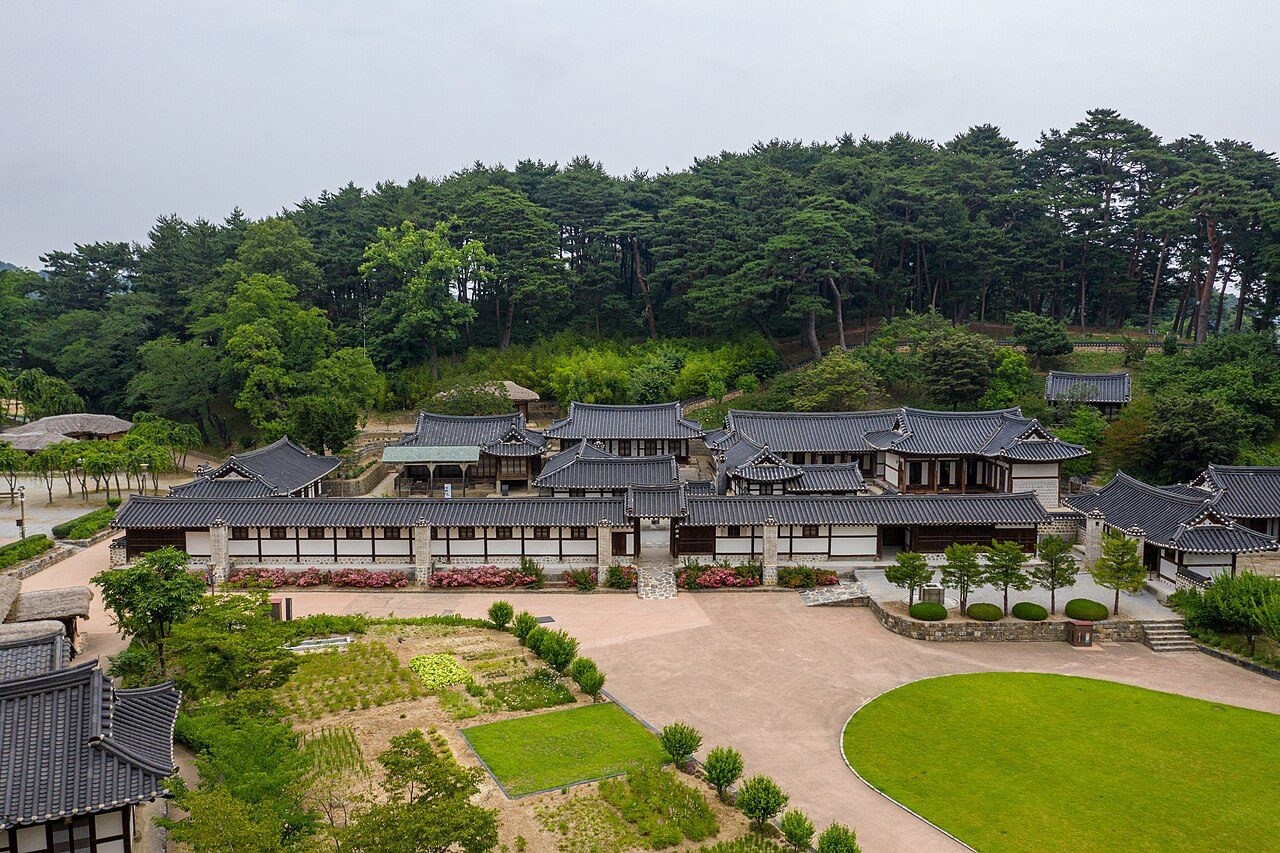
Seongyojang is the house of a branch of the royal Jeonju Yi clan near Gyeongpo Lake in Gangneung, on the east coast. It is among the largest private houses of the Joseon period still standing, a whole estate of separate buildings, from the women’s quarters and men’s hall to a pavilion on a lotus pond, laid out at the foot of a low hill. Descendants still look after it, and part of it is run as a hanok stay.
What makes it instructive is that it was never designed as a whole. The Korea Heritage Service notes that it grew building by building as the family lived in it, so it lacks the tight unity of a planned house but feels free and generous, with independent buildings set comfortably against the hillside. Walking from the low, practical anchae (안채) to the raised, formal men’s hall shows how a yangban (양반) household separated work, family and public life.
What to look at
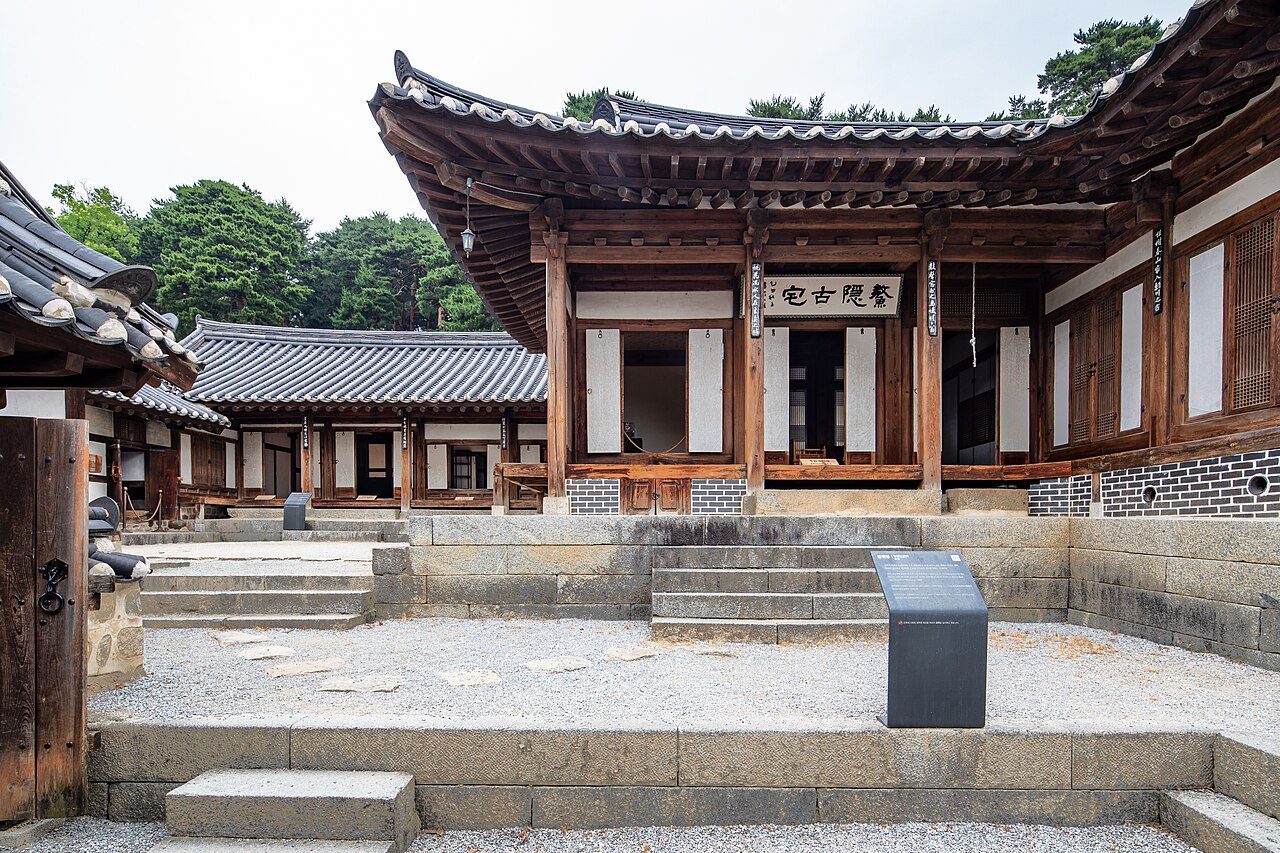
Yeolhwadang 열화당
The sarangchae (사랑채), built in 1815: a high floor above a spacious courtyard, the opposite of the low, enclosed anchae. Notice how the building’s height and open front project the family’s public face. It now houses a small library.
Anchae and Dongbyeoldang 안채와 동별당
The women’s house sits low with a narrow courtyard and a generous kitchen, built for a large household. The L-shaped east annexe attached to its right was the master’s private quarters, added in 1920.
Hwallaejeong 활래정
The pavilion on the square lotus pond outside the gate, built in 1816. Its floor juts out into the pond on stone pillars in an L-shaped plan, a classic Korean garden pavilion; tea programmes are held here.
The gate wings (haengnangchae) 행랑채
The long servants’ and storage wings along the front read almost like palace architecture. They show how many people a gentry estate supported.

History
The founder was Yi Nae-beon, an eleventh-generation descendant of Prince Hyoryeong, King Sejong’s elder brother. After his father’s death he moved with his mother from Chungju to the Gyeongpo area; family tradition says a troop of weasels led him to this wooded site. When the house was built, Gyeongpo Lake was larger and came close; the house’s own site explains that people crossed it on a bridge of boats, hence the name, ‘boat-bridge manor’. The lake margin has since become rice paddies.
The anchae, built first by Yi Nae-beon in the 18th century, has a large kitchen for an extended household and a deliberately plain, farmhouse feel. Yi Hu added the men’s hall, Yeolhwadang, in 1815, naming it from Tao Yuanming’s poem on returning home, and the pond pavilion Hwallaejeong the following year. The east annexe (Dongbyeoldang) was built by Yi Geun-u in 1920. The house’s own history says it was enlarged over ten generations and that in hard years the family opened its granaries to neighbours.
Seongyojang was designated National Folklore Cultural Heritage in the 1960s, as one of the earliest houses on the list. Its size is variously described as 99 kan (the family’s site), ‘more than 100 kan’ and 102 kan.
Getting there
KTX to Gangneung Station, then Gangneung city bus 202 to the Seongyojang stop
Take a KTX to Gangneung Station. Gangneung city bus 202 serves the Seongyojang stop, on a loop that also passes Ojukheon and Gyeongpo; VisitKorea notes that route 202 also stops across from Gangneung Station, and that variants 202-1 and 202-2 run from the Gyeongpo-dae area to Seongyojang in about six minutes. From the Seongyojang Entrance stop it is a 5-10 minute walk.
Seongyojang sits between downtown Gangneung and Gyeongpo Lake, so it combines easily with Ojukheon and the lakeside.
Route checked 15 November 2026 against: 오시는 길 (Seongyojang (official site)); 서울에서 강릉까지 KTX 당일치기! 동해바다 벚꽃 여행 코스 (VisitKorea Korean edition (Korea Tourism Organization)). Bus numbers and stops change: check the official page before you set off.
When to go
SpringSummerAutumnWinter
Summer is the time to see the lotus pond in bloom around Hwallaejeong; spring and autumn are mild on the coast.
Sources
- 강릉 선교장, Korea Heritage Service (National Heritage Portal) (read 15 November 2026)
- 선교장 역사, Seongyojang (official site) (read 15 November 2026)
- Seongyojang House, VisitKorea (Korea Tourism Organization) (read 15 November 2026)
- 역사와 전통이 숨 쉬는 한옥 강릉 선교장, VisitKorea Korean edition (Korea Tourism Organization) (read 15 November 2026)
- 오시는 길, Seongyojang (official site) (read 15 November 2026)