
온돌 · ondol
Ondol: the heated floor
How a fire lit outside the room warms its stone floor through flues beneath it, and why Korean life settled onto that floor.
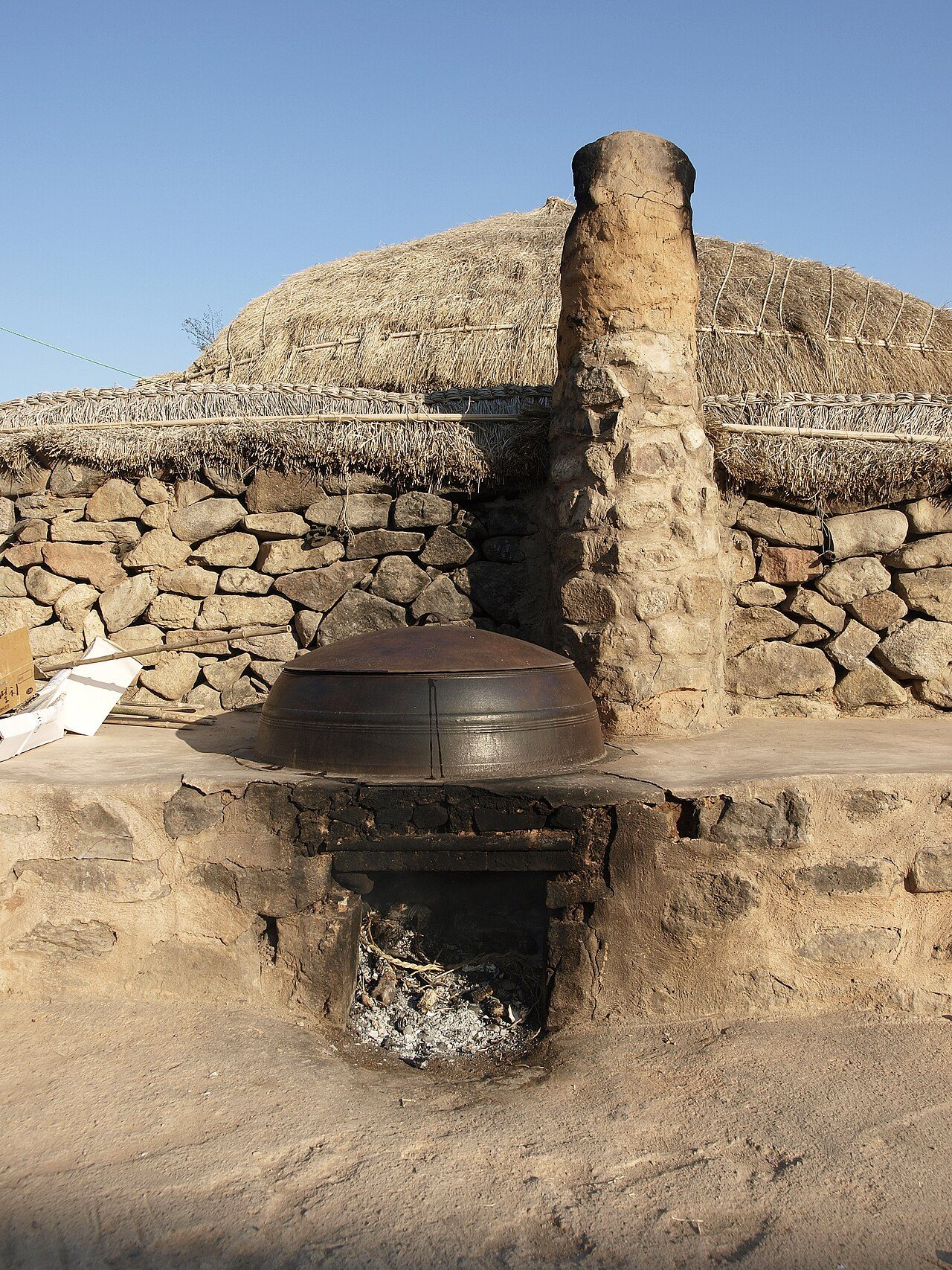
Walk round the outside of almost any old hanok and you will find low openings at the foot of the walls, blackened at the lip, and somewhere on the far side a squat chimney. Those are the two ends of the ondol (온돌), the heating system that runs under the floor of every warm room. The fire never enters the room. It burns in a mouth outside or in the kitchen, its heat and smoke are drawn sideways through channels under a floor of flat stones, and the smoke leaves by the chimney. The stones and the thick mud over them soak up the heat and give it back for hours.
Koreans also call the system gudeul (구들), the older native word. The Encyclopedia of Korean Culture suggests gudeul comes from words meaning ‘baked stone’ and ondol from ‘warmed stone’, and notes that ordinary speech still treats them slightly differently: you ‘put in’ gudeul, meaning the flue works, and ‘lay’ ondol, meaning the heated floor as a whole. Either way, the warm floor is the reason Koreans traditionally sat, ate and slept at floor level, and it shaped the house around it.
How the heat travels (an illustration drawn for this guide; proportions simplified, and flue layouts vary from house to house). Tap a number.
- Agungi 아궁이: the firebox mouth, below floor level, usually in the kitchen.
- Sot 솥: the iron cauldron set into the hearth: the same fire cooks rice and heats the room.
- Buneomgi 부넘기: a low hump just inside the firebox that keeps burning fuel back and pushes the flame up into the flues.
- Gorae 고래: the flue channels under the floor, separated by low ridges of stone and clay.
- Gudeuljang 구들장: flat stones laid across the ridges, then sealed with clay; they soak up the heat and give it back for hours.
- Jangpan 장판: the finished floor of layered, oiled paper over the clay, smooth and warm to sit and sleep on.
- Gaejari 개자리: a deep pit before the chimney where the gas slows, drops soot and is kept from blowing back.
- Gulttuk 굴뚝: the chimney, often standing apart from the house on the far side.
- Bueok 부엌: the kitchen, set lower than the room it heats so that the hot gas rises through the flues.
How the fire travels
The fire is laid in the agungi (아궁이), the firebox. Just inside it, the floor of the passage rises in a low earthen hump called the buneomgi (부넘기). The hump stops burning fuel and ash from tumbling straight into the flues and helps spread the flame across their mouths.
Beyond it lie the gorae (고래), the flues: parallel or fanning channels running under the whole room, separated by low ridges (goraeduk, 고래둑) on which the floor stones rest. Those stones are the gudeuljang (구들장), broad flat slabs fitted edge to edge. Hot gas moving along the flues heats them from below.
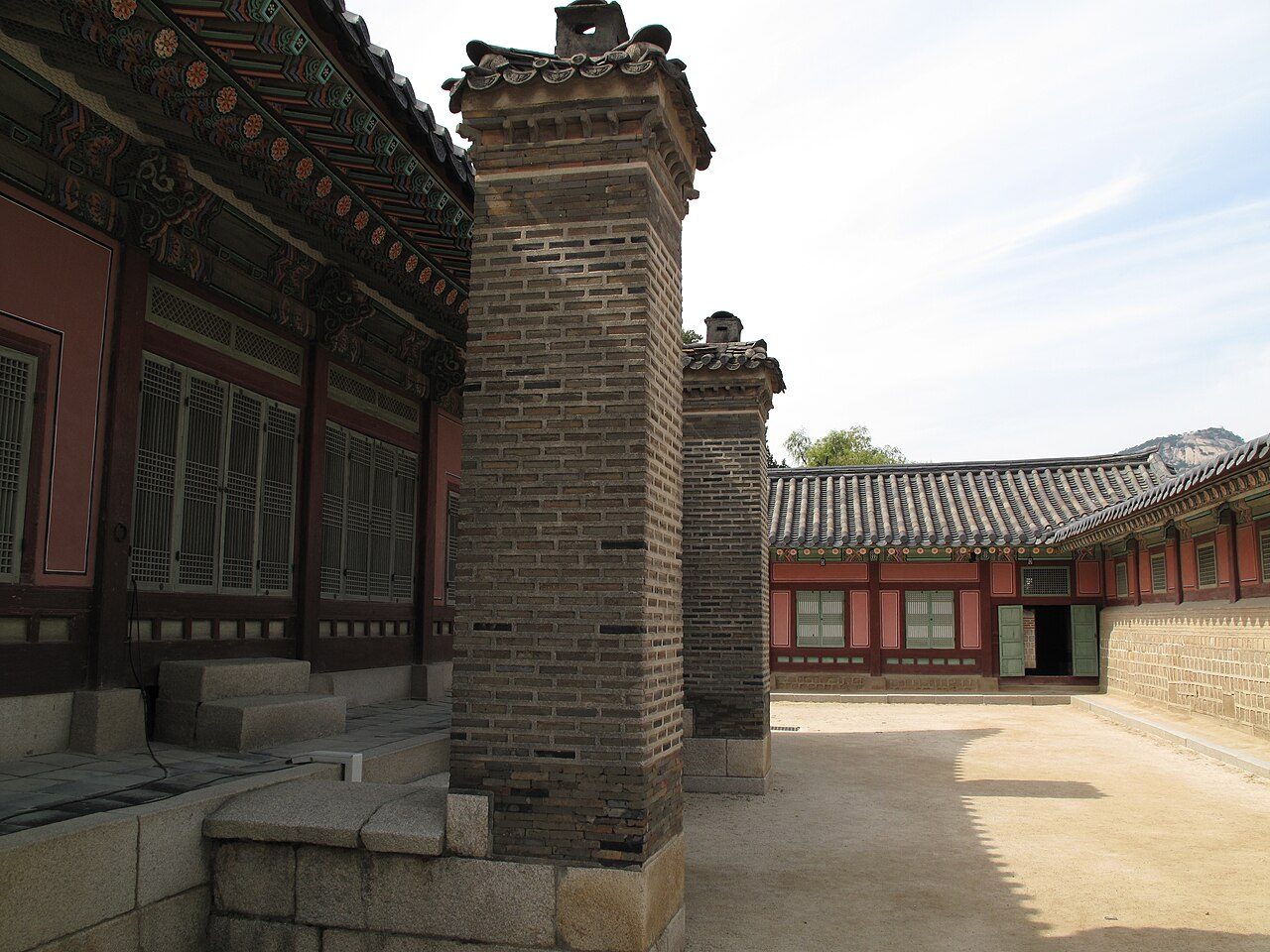
At the far end of the room the flues drop into the gaejari (개자리), a trench dug deeper than the flues. Smoke that has given up its heat slows here and drops soot and grit before it can clog the system. A short horizontal passage, the yeondo (연도), then leads to the gulttuk (굴뚝), the chimney. Builders were advised to put firebox and chimney far apart so the hot gas crosses the whole floor, and a taller chimney draws better and resists back-draught. The diagram traces this path from firebox to chimney.
Warm end and cool end
An ondol room is never evenly warm, and it was never meant to be. The end nearest the firebox is the araenmok (아랫목), literally the ‘lower spot’, and the far end near the chimney is the winmok (윗목), the ‘upper spot’. The stones are set lower at the araenmok and the mud over them is thickest there, while at the winmok the mud barely covers the slabs. Even so, the araenmok stays the hottest part of the room.
That gradient organised the household. The warmest place went to elders and guests; bowls of rice were tucked under quilts at the araenmok to keep warm for someone coming home late; things that should stay cool were kept towards the winmok. Rooms were usually small, which kept the floor area a single fire had to heat within reason.

The kitchen fire that heats the room
In many houses the firebox serving the main room is in the kitchen, built into the buttumak (부뚜막), the masonry hearth that holds the iron cauldrons. Cooking rice or boiling water for washing sent heat under the room next door, so the same fuel did two jobs. The Encyclopedia of Korean Culture distinguishes this hearth-type firebox from the hamsil agungi (함실아궁이), a firebox set into the wall itself.
The kitchen floor is therefore set well below the level of the room it serves: the fire has to sit lower than the flues so that the hot gas rises into them. When you step down into an old hanok kitchen, that drop is the ondol at work.
Fuel was whatever a household could gather: firewood, pine needles, rice straw. Fires were lit for cooking and topped up for heat in cold weather, and the mass of stone and mud let the room stay warm well after the flames died.
Two thousand years of floors
Nobody knows exactly when floor heating began. Claims for a Bronze Age pit house at Seopohang in the far north-east are disputed. Firm evidence comes from the Early Iron Age: the Encyclopedia of Korean Culture cites an L-shaped heated bench in a pit dwelling at Seodun-dong in Suwon dated after about 300 BCE, and similar remains in what is now North Korea. When the Cultural Heritage Administration announced in 2018 that it would list ondol culture as national intangible heritage, it described primitive ondol remains across the peninsula dated roughly to the 3rd century BCE to the 1st century CE.
These early systems were jjokgudeul (쪽구들), partial ondol: one to three flues running along one side of a room, often fed from a cooking hearth, with people sitting or lying on the warm strip. Chinese records describe Goguryeo homes as heated this way in winter. Heating the whole floor took centuries to become normal. Whole-floor ondol appear at temple sites in late Goryeo and early Joseon, spread through yangban houses in the 16th and 17th centuries, and reached ordinary homes later still. A 15th-century gazetteer and a 17th-century account of Jeju both describe commoners without fireboxes or heated floors.
Risks: fire, smoke and coal gas
A wooden house with a fire under it needs care. The stone at the firebox face was plastered with clay so flames could not reach nearby timber, and floors were sealed with layers of mud and papered over with oiled floor paper (jangpan, 장판). Cracks let smoke into the room, so they were patched before every re-papering. The flues also needed clearing of soot and ash every few years.
The real danger came in the 20th century. From the mid-1950s households switched to yeontan (연탄), anthracite coal briquettes, burned in the same fireboxes. National Archives of Korea material records that newspapers reported deaths from briquette gas every winter from the 1960s, with hundreds of people dying each year: the carbon monoxide seeped up through cracks in the floor and walls. The problem faded only when gas and oil boilers became common in the 1990s.
Ondol today
Modern Korean flats are still heated through the floor, but by hot water pumped through pipes in the slab, a descendant of the idea rather than of the structure. Traditional stone-and-flue ondol survives in heritage houses, some rural homes and some hanok stays, where you may be able to see the firebox in use. Korea listed ondol culture as national intangible heritage in 2018 with no individual holder named, treating it as a way of living shared across the whole peninsula, as it had earlier done for Arirang and kimchi-making.
What to look for
- Blackened firebox openings at the foot of the walls or inside the kitchen, below floor level
- A low chimney standing apart from the wall on the opposite side of the house
- The step down into the kitchen: the hearth sits lower than the room it heats
- Glossy yellow-brown oiled floor paper in the rooms, often darker near the warm end
- In winter, where people sit: guests are offered the warm end nearest the firebox
Sources
- 구들 (Gudeul), Encyclopedia of Korean Culture, Academy of Korean Studies (read 15 November 2026)
- Ondol becomes national intangible heritage item, Korea.net (read 15 November 2026)
- ‘온돌문화’ 국가무형문화재 지정 예고, Kyunghyang Shinmun (read 15 November 2026)
- 연탄 (Coal briquettes), Korea of Record, National Archives of Korea (read 15 November 2026)
- Ondol, Wikipedia (lead only) (read 15 November 2026)